
Celery
Apium graveolens L.
Celery (Apium graveolens L.) is an aromatic herb of the carrot family (Apiaceae) with grooved, strongly scented stalks. According to Kew POWO its native range runs from Macaronesia to North Africa and from Europe to the Western Himalaya; it is a biennial of the temperate biome, now widely cultivated and naturalised in three main forms: stalk celery (var. dulce), celeriac (var. rapaceum) and leaf celery (var. secalinum). Its main bioactives are phthalides (3-n-butylphthalide, sedanolide), the flavones apigenin and luteolin, essential oil (limonene, selinene) and furanocoumarins (psoralen, bergapten). Celery is studied for antihypertensive, antioxidant, anti-inflammatory and diuretic effects. Note: furanocoumarins can cause photosensitivity on skin contact.
No ratings yet — be the first!
Gallery
 Celery — Botanical plateCelery — Plant
 Celery — Leaves & stalks
 Celery — Wild form
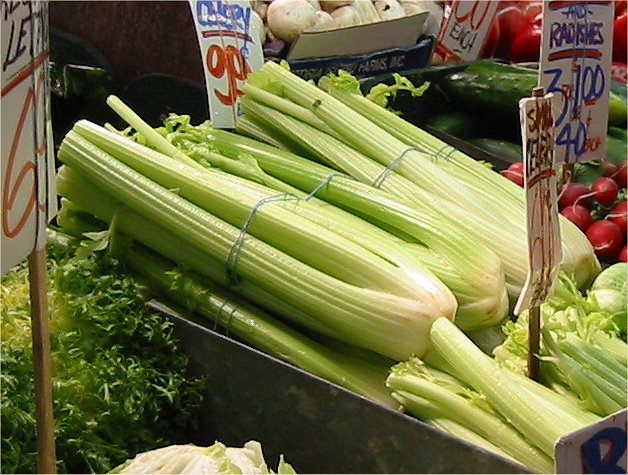 Celery — Stalk celery (var. dulce)
 Celery — Plant by the waterCelery — Botanical plateCelery — Plant
Overview
Celery (Apium graveolens L.) is a biennial herb — sometimes a perennial that flowers only once and then dies — about 30–100 cm tall when grown as a vegetable and up to 1–1.5 m when it sends up its flowering stem. The whole plant has the characteristic celery odour. The stem is erect, smooth, solid, with conspicuous longitudinal grooves and branches near the top. The leaves are bright green, 1- to 2-pinnate, with long stalks bearing sheathing bases; the leaflets are rhomboid to ovate with toothed margins, up to about 6 cm long and 4 cm broad. The inflorescence is a compound umbel of 4–12 mostly short rays bearing many small creamy-white to greenish-white flowers 2–3 mm across, with five sepals and five petals. The fruit is a schizocarp, broadly ovoid to almost globose, 1–1.5 mm long and ribbed; the seeds are small and brown. Celery is the type species of the genus Apium — the type genus of the family Apiaceae — in the order Apiales, giving it special taxonomic significance.
According to Kew POWO, the native range of Apium graveolens runs from Macaronesia (the Canary Islands, Madeira…) and North Africa through Europe to the Western Himalaya; it is a biennial of the temperate biome that favours cool, moist places. The wild form (often called 'smallage' or wild celery) grows in brackish marshes, on coasts and on damp ground, and is smaller, tougher and more bitter than the cultivated forms. Over thousands of years of selection, growers produced three main groups: stalk celery (var. dulce), grown for its fleshy leaf stalks; celeriac (var. rapaceum), grown for its swollen underground corm; and leaf celery (var. secalinum), grown for its leaves and used as a herb. Today celery is cultivated and naturalised across Europe, Asia, the Americas and Oceania. In Vietnam celery is a familiar northern vegetable that thrives in the cool season and is grown mainly in the winter–spring crop.
Chemically, celery contains three main groups of bioactives. The first is the phthalides — most notably 3-n-butylphthalide (NBP) and sedanolide — which give the characteristic aroma and are concentrated in the seed oil. The second is the flavonoids: celery is one of the vegetable sources richest in apigenin (as glycosides such as apiin) together with luteolin; these flavones are much studied for anti-inflammatory and antioxidant activity. The third group is the volatile oil, including limonene, selinene and linalool, together with furanocoumarins (psoralen, bergapten, xanthotoxin) and coumarins — the group responsible for photosensitivity. The stalks and corm are watery (about 90–95% water) and supply dietary fibre, mannitol, vitamins K and C, folate, and the minerals potassium, calcium and magnesium; celery seed yields 2–3% essential oil. Phthalide and essential-oil levels are far higher in the seed and in the wild form than in cultivated stalks.
Celery is used mainly as a vegetable and flavouring: in Vietnam celery stir-fried with beef and served with Nam Vang noodles is a familiar dish; celeriac is stewed and leaf celery flavours soups. Worldwide, celery forms the aromatic base of mirepoix/sofrito, features in salads and juices, and its seed is a spice, while celeriac is mashed or roasted. In traditional medicine celery and celery seed are used as a diuretic and for high blood pressure, gout, rheumatism and digestion. In research, a Wiley review (2024) concluded that celery's antihypertensive effect is linked to 3-n-butylphthalide and apigenin; work by Sohrabi et al. (2021) showed that celery-seed extract has a vasodilatory effect; and the review by Daoud et al. (2025) summarises its anti-inflammatory, antioxidant and antihypertensive activities. Notably, 3-n-butylphthalide isolated from celery seed has been developed into a medicine for ischaemic stroke in China, and in vivo/in vitro studies (Gao et al., 2025) continue to clarify the mechanisms of its phthalides and flavonoids.
As food, celery is safe for people at normal levels, low in calories and rich in fibre. However, its furanocoumarins (psoralen, bergapten) can cause photosensitive dermatitis — recorded in people who harvest and process celery (celery dermatitis). Celery is a common food allergen in Europe, linked to the celery–mugwort–spice syndrome and to birch-pollen allergy. Because it is rich in vitamin K, people taking anticoagulants (warfarin) should keep their intake steady; celery-seed oil and extract, being high in phthalides, are not recommended in pregnancy because they may stimulate the uterus, and high doses should not be taken long-term. On conservation, the species Apium graveolens has not been assessed globally on the IUCN Red List (NE) and is not listed in the CITES appendices; it is widely cultivated and not globally threatened, although the wild form has become rare in parts of its native range (for example in Britain) owing to the loss of coastal marshes and damp ground. Conservation priorities are maintaining local celery varieties and coastal wild-celery populations, which are valuable gene sources for disease resistance, salt tolerance and quality.
Life cycle
From seed to productSeedling & foliage
A vigorous young plant with the characteristic celery odour in all parts.
Flowering (umbels)
In its second year it produces creamy-white umbels and then seeds.
Fruit & seed
The small schizocarp is 1–1.5 mm; celery seed is used as a spice.
Harvest
Stalk celery is cut at the base, celeriac dug for its corm, leaf celery picked year-round.
Distribution & origin
Share of recorded occurrences by region- Europe · Mediterranean · Macaronesia (native)26%
- North Africa · West Asia16%
- Western Himalaya8%
- North America · Oceania (introduced)16%
- China · East Asia16%
- Vietnam · Southeast Asia10%
- Elsewhere (Latin America, Africa…)8%
Chemical composition
Relative content in agarwood resin- Phthalides (3-n-butylphthalide, sedanolide)Aroma and vasodilation; abundant in seed oil26%
- Flavones apigenin & luteolin (as apiin)Antioxidant, anti-inflammatory; celery is apigenin-rich22%
- Volatile oil (limonene, selinene, linalool)Characteristic aroma18%
- Furanocoumarins & coumarins (psoralen, bergapten, xanthotoxin)Phototoxic/photosensitising12%
- Vitamins & minerals (K, C, potassium, calcium, magnesium)Micronutrients12%
- Fibre, mannitol & organic acidsCrisp texture and digestive support10%
Uses
- Vietnam: celery stir-fried with beef, served with Nam Vang noodles, in soups/stews; celeriac braised
- World cuisine: mirepoix/sofrito base, salads, juices, mashed/roasted celeriac
- Spice: celery seed, celery salt and celery powder in seasoning blends
- Traditional medicine: diuretic, support for blood pressure, gout and rheumatism, digestive stimulant
- Nutraceutical/essential oil: celery-seed extract rich in phthalides
- Research & pharma: 3-n-butylphthalide for ischaemic stroke; anti-inflammatory apigenin
Properties
- Stem
- Solid with conspicuous grooves, pungent
- Leaf
- 1–2-pinnate, rhomboid leaflets
- Flower
- Small creamy-white umbels
- Taste
- Aromatic, slightly bitter, crisp
Habitat & conservation
Celery is a temperate species that favours a cool, moist climate; the optimum is about 15–21 °C, and it tolerates cold fairly well but tends to bolt (flower early) under unusual heat or prolonged cold. It needs deep, loose, humus-rich soil that holds moisture yet drains freely, at pH about 6.0–6.8, with plenty of sun; because its roots are shallow it needs a steady water supply. The wild form grows in brackish marshes and along coasts. According to POWO celery is a biennial of the temperate biome and has been introduced and naturalised widely. In Vietnam celery suits the cool season in the north, grown in the winter–spring crop to limit early bolting and give tender, sweet stalks.
Conservation
On the IUCN Red List the species Apium graveolens has no global assessment (NE) and is not listed in the CITES appendices. It is widely cultivated and naturalised worldwide and so is not globally threatened. Nevertheless the wild form has declined in parts of its native range — for example in Britain, where the loss of coastal marshes and damp ground has made it rare — and is protected under some local lists. Conservation priorities: maintaining the diversity of local celery varieties (stalk, celeriac and leaf) in genebanks and on-farm, and protecting coastal wild-celery populations as a source of genes for salt tolerance and disease resistance.
References
- 1Plants of the World Online — Apium graveolens L. — Kew Science, 2026
- 2Antihypertensive Property of Celery: A Narrative Review on the Role of Bioactive Compounds — Wiley (onlinelibrary), 2024
- 3The vasodilatory effect of Apium graveolens L (celery) seed — Sohrabi et al. — PMC7885007, 2021
- 4Therapeutic potential and bioactive compounds of Apium graveolens — ScienceDirect (Daoud et al.), 2025
- 5Current Research Status of in vivo and in vitro Applications of Celery — Natural Product Communications (Gao et al.), 2025
- 6FoodData Central — Celery, raw — US Department of Agriculture (USDA), 2024
- 7Apium graveolens — taxonomy and compounds — PubChem, NIH NCBI, 2025
- 8Apium graveolens L. — World Flora Online — World Flora Online, 2025