
Celery
Apium graveolens L.
Celery (Apium graveolens) is an aromatic herb of the carrot family with grooved, strongly scented stalks; stir-fried with beef or used in soups, and traditionally used to support blood pressure and as a diuretic.
No ratings yet — be the first!
Gallery
 Celery — Botanical plateCelery — Plant
 Celery — Leaves & stalks
 Celery — Wild form
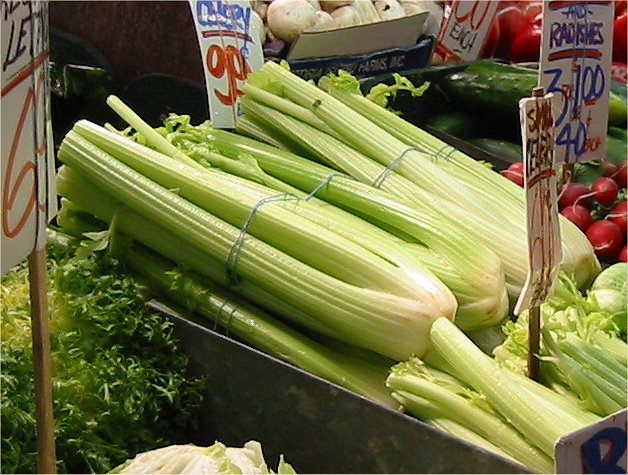 Celery — Stalk celery (var. dulce)
 Celery — Plant by the waterCelery — Botanical plateCelery — Plant
Overview
A stout biennial or monocarpic perennial herb growing up to 1–1.5 m, with a strong celery odour throughout. Stems are solid with conspicuous grooves. Leaves are bright green, 1- to 2-pinnate, with often rhomboid leaflets up to 6 cm long and 4 cm broad. Flowers form umbels, mostly with short peduncles and 4–12 rays; the individual flowers are creamy-white to greenish-white, 2–3 mm across. The fruit is a schizocarp, broadly ovoid to globose, 1–1.5 mm. It is the type species of the genus Apium, the family Apiaceae and the order Apiales.
Cultivated celery has three main forms: stalk celery (var. dulce), celeriac (var. rapaceum) and leaf celery (var. secalinum). In Vietnam, celery stir-fried with beef is a familiar dish, often served with Nam Vang noodle soup; the plant thrives in the cool season. It contains about 90.5% water plus vitamins A, B, C and P, choline, tyrosine, glutamic acid and the minerals Mg, Mn, Fe, I, Cu, K and Ca, and yields 2–3% essential oil on distillation. The roots and corm are used in folk medicine to support high blood pressure and as a diuretic for oedema.
Life cycle
From seed to productSeedling & foliage
A vigorous young plant with the characteristic celery odour in all parts.
Flowering (umbels)
In its second year it produces creamy-white umbels and then seeds.
Fruit & seed
The small schizocarp is 1–1.5 mm; celery seed is used as a spice.
Harvest
Stalk celery is cut at the base, celeriac dug for its corm, leaf celery picked year-round.
Distribution & origin
Share of recorded occurrences by region- Vietnam (grown as a vegetable)20%
- Europe · Mediterranean (native)40%
- West Asia · North Africa20%
- Naturalized worldwide20%
Chemical composition
Relative content in agarwood resin- Essential oil (2–3%)Gives the characteristic celery aroma (phthalides)30%
- Vitamins K & CGood levels in the leaf stalks20%
- Minerals (K, Ca, Mg, Fe, I)From fresh-vegetable composition20%
- Choline, tyrosine, glutamic acidSoluble nitrogenous compounds15%
- Vitamin P (flavonoids)Present in fresh celery15%
Uses
- Vietnam: stir-fried with beef, served with Nam Vang noodles, in soups
- World cuisine: salads, mirepoix, celery seed as a spice, celeriac
- Folk medicine: to support high blood pressure and as a diuretic for oedema
Properties
- Stem
- Solid with conspicuous grooves, pungent
- Leaf
- 1–2-pinnate, rhomboid leaflets
- Flower
- Small creamy-white umbels
- Taste
- Aromatic, slightly bitter, crisp
Habitat & conservation
An Old World species favouring moist, cool places, often on coastal ground and marshes, and now naturalized worldwide. In Vietnam it is grown year-round but thrives best in the cool season.
Conservation
Not Evaluated on the IUCN Red List. Celery is widely cultivated and naturalized worldwide and is not threatened.
References
- 1Plants of the World Online — Apium graveolens L. — Kew Science, 2026
- 2Apium graveolens (celery) — mô tả, phân loại — English Wikipedia, 2026
- 3Cần tây — mô tả, công dụng, thành phần hóa học — Vietnamese Wikipedia, 2026
- 4FoodData Central — Celery, raw — USDA, 2024
- 5Nguồn ảnh: Megustanlasframbuesas (CC BY-SA 4.0) — Wikimedia Commons,
- 6Nguồn ảnh: Szabi237 (CC BY 3.0) — Wikimedia Commons,
- 7Nguồn ảnh: Kristian Peters (CC BY-SA 3.0) — Wikimedia Commons,
- 8Nguồn ảnh: Eric Hunt (CC BY 2.5) — Wikimedia Commons,
- 9Nguồn ảnh: MPF (CC BY-SA 4.0) — Wikimedia Commons,
- 10Nguồn ảnh: Amédée Masclef (Public domain) — Wikimedia Commons,