
Soybean
Glycine max (L.) Merr.
The soybean (Glycine max (L.) Merr.) is a legume of the family Fabaceae rich in protein (about 36–40%) and oil (about 18–20%), and is the world's most important oil- and protein-producing crop. According to Kew POWO its native range is the Russian Far East to China and temperate East Asia; the cultivated soybean (subsp. max) is a cultigen from China, Japan and Taiwan whose wild ancestor is the wild soybean Glycine soja. The seed contains three main isoflavones — genistein, daidzein and glycitein (as genistin, daidzin and glycitin) — together with saponins, phytosterols, lecithin and vitamin E. Isoflavones are much studied for cardiovascular, bone and women's health; in 1999 the FDA accepted a health claim for soy protein and cholesterol reduction. Soybean is one of the eight major food allergens; raw seeds must be thoroughly cooked.
No ratings yet — be the first!
Gallery
 Soybean — SeedsSoybean — Plant
 Soybean — Plant & leaves
 Soybean — Flower
 Soybean — Flower cluster
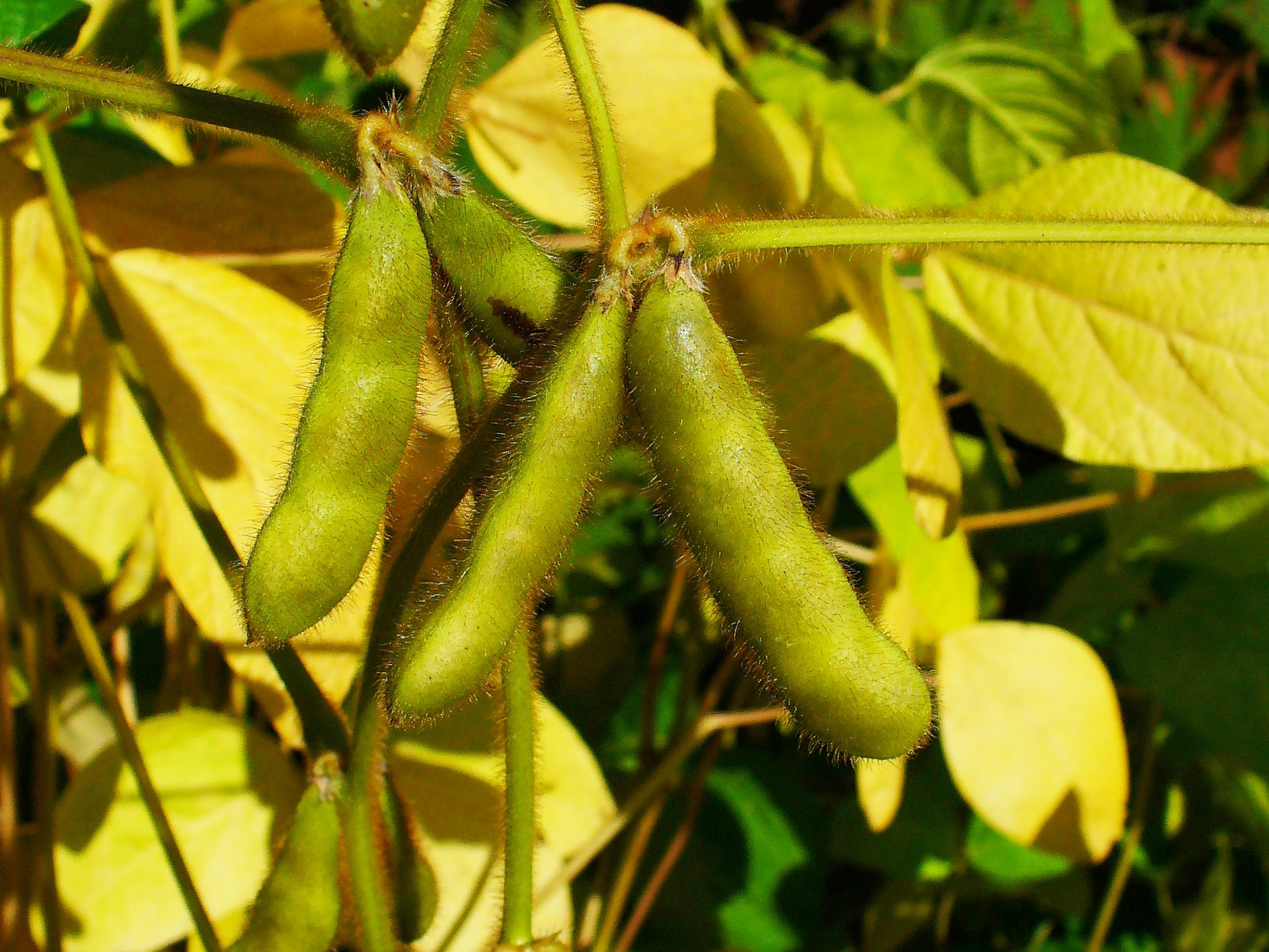 Soybean — Pods & seedsSoybean — SeedsSoybean — Plant
Overview
The soybean (Glycine max (L.) Merr.) is an annual herb 0.2–2 m tall with an erect, branching, brownish-hairy stem. The leaves are trifoliate with small stipules; the leaflets are ovate to rhombic, entire and hairy on both surfaces. The small papilionaceous (pea-like) flowers are white to pale purple and borne in short axillary racemes; the plant usually self-pollinates. The fruit is a hairy, slightly curved legume pod 3–8 cm long containing 2–4 seeds. The seeds are spherical to oval, 5–11 mm across, with a yellow, green, brown or black coat depending on cultivar and a prominent hilum; the chromosome number is 2n = 40. The root system has a taproot and lateral roots bearing nodules formed by symbiotic nitrogen-fixing bacteria (Bradyrhizobium), which leave nitrogen in the soil.
According to Kew POWO, the native range of the species Glycine max is the Russian Far East to China and temperate East Asia; the cultivated subspecies Glycine max subsp. max is a cultigen from China, Japan and Taiwan. The wild ancestor is the wild soybean Glycine soja, which occurs in eastern China, Japan, Korea and the Russian Far East and is today the most important wild relative of the crop. Soybean was domesticated in China several thousand years ago, recorded as a crop as early as the Zhou dynasty, and then spread to Korea, Japan and Southeast Asia, and to the rest of the world over the last few centuries. Today the United States, Brazil and Argentina are the largest producers, followed by China and India. In Vietnam, soybean is grown mainly in the spring and summer–autumn seasons, often in rotation with rice in the lowlands and midlands.
Chemically, soybean stands out for its high protein and oil content. Protein makes up about 36–40% of dry weight, mainly the storage globulins glycinin (11S) and conglycinin (7S); it is rich in lysine but low in methionine and yields bioactive peptides on hydrolysis. Oil makes up about 18–20% and is rich in unsaturated fatty acids: linoleic acid (omega-6), oleic acid and some alpha-linolenic acid (omega-3), together with lecithin (phosphatidylcholine) and vitamin E (tocopherols). Its most characteristic group of bioactives is the isoflavones — genistein, daidzein and glycitein, present in the seed mainly as the glycosides genistin, daidzin and glycitin (about 0.1–0.3% of dry weight); genistein is regarded as the most biologically active isoflavone. The seed also contains saponins, phytosterols, dietary fibre, vitamins K and B, and the minerals potassium, calcium, magnesium, iron and phosphorus. As anti-nutrients, raw seed contains trypsin inhibitors (Kunitz and Bowman-Birk), lectins and phytate — reduced by cooking or fermentation; the oligosaccharides raffinose and stachyose (alpha-galactosides) cause flatulence because people cannot digest them.
Soybean is used widely as food and industrial raw material. In Vietnam the seeds are made into tofu, soy milk, fermented bean paste, soft tofu pudding, yuba and boiled edamame; worldwide there are also soy sauce, fermented pastes, tempeh (Indonesian fermentation) and natto (Japan). Soybean oil is used for cooking and in food manufacturing; the meal (left after oil extraction) is an important livestock feed; the oil and seed are also used for biodiesel, printing inks and bioplastics. In research, in 1999 the US Food and Drug Administration (FDA) authorised a health claim for soy protein (25 g/day) reducing cholesterol and heart-disease risk; the review by Kim et al. (2021) highlights genistein as the most promising isoflavone for cancer prevention, with antioxidant, anti-inflammatory and metabolic effects; Yu et al. (2021) analyse the dual role of genistein in women's health (reducing BMI in postmenopausal women, weak oestrogenic action, with cautions in some hormone-dependent cancers); Ahmad et al. (2024) review the benefits of daidzein (menopausal symptoms, bone, cardiovascular); and Kang et al. (2023) assess soybean in the era of precision medicine, noting that isoflavones improve osteoporosis and hot flushes. Some people produce equol when they eat soy and may benefit more.
As food, soybean and soy products are familiar, but soybean is one of the eight major food-allergen groups (with milk, egg, fish, shellfish, peanut, tree nuts and wheat) and can cause reactions ranging from mild to anaphylaxis. Raw soybean contains trypsin inhibitors and lectins, so it must be thoroughly cooked or fermented before eating; its oligosaccharides cause flatulence in sensitive people. Isoflavones are phytoestrogens: the evidence is generally reassuring for food-level intake, but high-dose isoflavone supplements warrant caution in people with a history of hormone-dependent cancer, in pregnancy and in young children, and medical advice should be sought. Soy may reduce the absorption of thyroid medicine (levothyroxine), so the two should be taken well apart and hypothyroid patients should be monitored. Most commercial soybean is now genetically modified (GM). On conservation, the species Glycine max has no global IUCN Red List assessment (NE) and is not listed in the CITES appendices; as a global staple crop its germplasm is widely conserved in international genebanks and it is not threatened. Nevertheless, dependence on a few commercial hybrids erodes landraces and genetic diversity, and the wild soybean Glycine soja is a wild relative carrying valuable genes for disease resistance, drought tolerance and seed quality that should be conserved in situ and in genebanks.
Life cycle
From seed to productGermination
Soybean seeds germinate in moist soil; the radicle grows down and the shoot grows up.
Seedling & leaves
The plant grows as an erect bush; leaves are hairy and trifoliate.
Flowering
Small pea-like flowers, white or pale purple, in axillary racemes.
Pods & ripe seeds
The hairy pod holds 2–4 seeds; on ripening the pod turns brown and the seeds harden.
Distribution & origin
Share of recorded occurrences by region- China · East Asia (origin & gene source)20%
- United States (major producer)18%
- Brazil18%
- Argentina12%
- India8%
- Other Asia (incl. Vietnam, Japan, Korea)14%
- Elsewhere (Europe, Africa, Oceania)10%
Chemical composition
Relative content in agarwood resin- Protein & amino acids (glycinin, conglycinin)~36–40%; rich in lysine; source of bioactive peptides34%
- Oil & lecithin (linoleic, oleic, ALA)~18–20%; unsaturated fatty acids, phosphatidylcholine, vitamin E21%
- Carbohydrate & oligosaccharides (raffinose, stachyose)Energy source; alpha-galactosides cause flatulence17%
- Isoflavones (genistein, daidzein, glycitein)Phytoestrogens; antioxidant, cardiovascular, bone12%
- Dietary fibreDigestive and gut-microbiome support8%
- Vitamins & minerals (E, K, Fe, Ca, K, Mg)Micronutrients5%
- Saponins & phytosterolsCholesterol-lowering, bioactive3%
Uses
- Vietnam: tofu, soy milk, fermented bean paste, soft tofu pudding, yuba; boiled edamame
- Traditional processing: soy sauce, fermented pastes, tempeh, natto, yuba, okara
- Soybean oil for cooking and food industry; meal as livestock feed
- Traditional medicine & nutrition: soy protein lowers cholesterol (FDA 1999); isoflavones for cardiovascular and women's health
- Nutraceutical: isoflavones, protein isolate, soy peptides
- Agriculture & green industry: nitrogen-fixing rotation, biodiesel, printing ink, bioplastics
Properties
- Stem
- Erect branching herb, 0.2–2 m tall
- Leaf
- Trifoliate compound leaf, finely hairy
- Flower
- Pea-like (papilionaceous), white/pale purple
- Fruit
- Hairy legume pod with 2–4 seeds
- Root
- Nodules with nitrogen-fixing bacteria
Habitat & conservation
Soybean originates from East Asia and is an annual crop that likes a warm climate; it needs loose, humus-rich, well-drained soil at pH about 6.0–7.0 and plenty of sun, and it responds to day length, so each region chooses suitable varieties. It is symbiotic with nodulating bacteria (Bradyrhizobium) and the seed is often inoculated before sowing. According to POWO soybean is an annual of the temperate biome and has been widely cultivated. It is sensitive to waterlogging and to several diseases (rust, leaf spot, downy mildew). In Vietnam soybean is grown mainly in the spring and summer–autumn seasons, often in rotation with rice in the lowlands and midlands.
Conservation
On the IUCN Red List the species Glycine max has no global assessment (NE) and is not listed in the CITES appendices. It is a global staple crop whose germplasm is widely conserved in international genebanks (such as the USDA Soybean Germplasm Collection) and it is not threatened. Nevertheless, dependence on a few commercial hybrids erodes landraces and genetic diversity, and most commercial soybean is genetically modified. The wild soybean Glycine soja — the wild ancestor — carries valuable genes for disease resistance, drought and salt tolerance and seed quality and should be conserved in situ and in genebanks. Conservation priorities: maintaining the diversity of soybean varieties (especially local and traditional ones) and populations of G. soja.
References
- 1Plants of the World Online — Glycine max (L.) Merr. — Kew Science, 2026
- 2Current Perspectives on the Beneficial Effects of Soybean Isoflavones and Their Metabolites for Humans — Kim et al. — Antioxidants (MDPI) 10:1064, 2021
- 3Genistein: Dual Role in Women's Health — Yu et al. — PMC8472782, 2021
- 4A review on daidzein as food supplement: exploring its health benefits — Ahmad et al. — Wiley (Food Frontiers), 2024
- 5Benefits of Soybean in the Era of Precision Medicine — Kang et al. — Journal of Medicinal Food, 2023
- 6Soy protein health claim — 21 CFR 101.82 — US Food and Drug Administration (FDA), 1999
- 7FAOSTAT — Crops and livestock products (soybeans) — Food and Agriculture Organization (FAO), 2024
- 8FoodData Central — Soybeans, mature seeds, raw — US Department of Agriculture (USDA), 2024