
Gboma eggplant
Solanum macrocarpon L.
Gboma eggplant (Solanum macrocarpon) is a nightshade herb with small round white or pale-purple fruit, usually pickled, grilled or cooked in soup; native to Africa, widely grown in Vietnam.
No ratings yet — be the first!
Gallery
 Gboma eggplant — Ripe fruitGboma eggplant — Plant
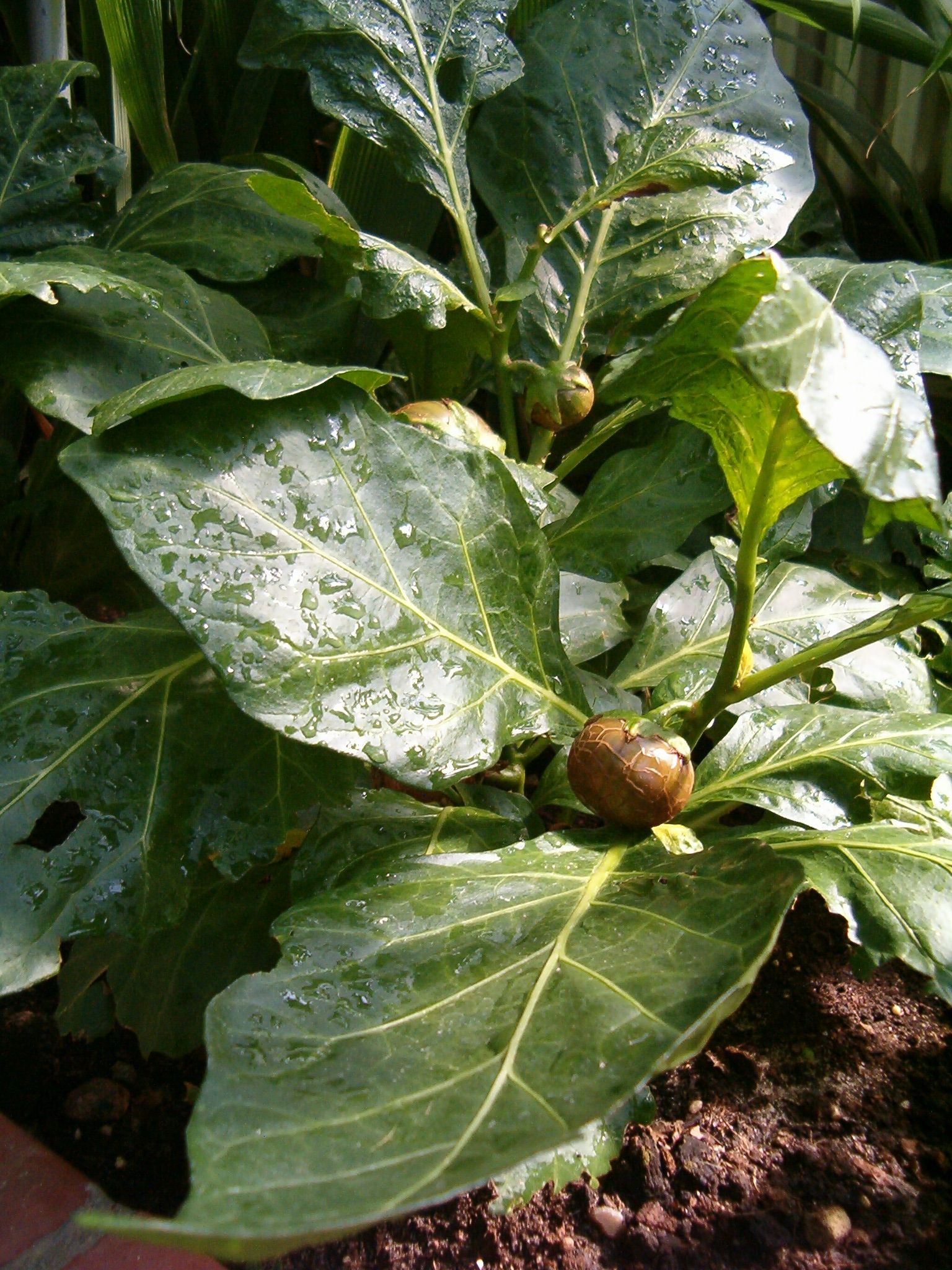 Gboma eggplant — Fruiting plant
 Gboma eggplant — Flower
 Gboma eggplant — Fruit
 Gboma eggplant — Fruit on plantGboma eggplant — Ripe fruitGboma eggplant — Plant
Overview
Gboma eggplant (Solanum macrocarpon) is a herb or small shrub of the nightshade family (Solanaceae), 0.5–1.5 m tall, with branching stems that often bear small prickles. Leaves are alternate, ovate to elliptic, 10–20 cm long, with wavy, shallowly lobed margins; the veins sometimes carry small prickles and both surfaces are hairy. The flowers are bisexual, white or pale purple, star-shaped with five petals, borne in small axillary clusters and insect-pollinated. The fruit is a spherical berry 3–5 cm across, glossy greenish-white when young and yellowing at maturity; the flesh is white and spongy and holds many flat, pale-yellow seeds. The young fruit is crisp and slightly astringent, usually less bitter than the common eggplant.
Gboma eggplant is native to tropical Africa, domesticated long ago and introduced into Southeast Asia, where Vietnam is a major home-garden crop throughout the countryside. The plant likes warm, humid conditions and is grown from seed at the start of the rainy season, fruiting after 2–3 months. The young fruit is a rustic Vietnamese staple: pickled and eaten with shrimp paste and pork belly, or grilled, fried, braised and cooked in soup. In traditional medicine the fruit is sweet and cooling (the mature fruit is considered mildly toxic) and is used to clear heat, promote urination and reduce inflammation; the leaves and roots are used in folk remedies for swellings and boils. It is a familiar home-garden vegetable with a harvest lasting through the summer.
Life cycle
From seed to productPlant
Small branching shrub with small prickles; ovate leaves.
Fruiting plant
Field-grown plant bearing many greenish-white young fruit.
Flower
White/pale-purple star-shaped flowers in small axillary clusters.
Fruit
Round glossy white fruit — pickled, grilled or braised.
Distribution & origin
Share of recorded occurrences by region- Vietnam & Southeast Asia30%
- Central & West Africa30%
- South Asia15%
- Latin America & Caribbean15%
- Others10%
Chemical composition
Relative content in agarwood resin- WaterYoung fruit92%
- Carbohydrate5%
- Dietary fibre1.5%
- Protein1%
- Minerals & vitamins0.5%
Uses
- Food: pickled gboma eggplant with shrimp paste and pork belly — a signature rustic dish
- Food: grilled, fried, braised eggplant and soups with fish or meat
- Folk medicine: young fruit clears heat, diuretic; leaves/roots applied to swellings and boils
- Home garden: easy, familiar vegetable with a long summer harvest
Properties
- Growth form
- Small shrub 0.5–1.5 m, small prickles
- Leaf
- Ovate, wavy margin, hairy
- Flower
- White/pale purple, star-shaped
- Fruit
- Round 3–5 cm, white flesh, many seeds
Habitat & conservation
Gboma eggplant likes a warm humid climate and loose, humus-rich, well-drained soil in full sun; grown from seed or seedlings at the start of the rainy season and fruiting after 2–3 months. In Vietnam it is grown throughout the countryside, from the lowlands to the midlands, around homes and gardens.
Conservation
A widespread cultivated species, not threatened; not listed by IUCN/CITES. Note: the mature fruit contains mild solanine and should not be eaten in quantity.
References
- 1Plants of the World Online — Solanum macrocarpon L. — Kew Science, 2026
- 2Solanum macrocarpon (Gboma eggplant) — mô tả, phân bố — English Wikipedia, 2026
- 3Cà pháo — mô tả, ẩm thực Việt Nam — Vietnamese Wikipedia, 2026
- 4Solanum macrocarpon — PROTA (Plant Resources of Tropical Africa) — PROTA, 2024
- 5Nguồn ảnh: Krzysztof Ziarnek (CC BY-SA 4.0) / Marco Schmidt (CC BY-SA 3.0) / Vinayaraj (CC BY-SA 3.0) — Wikimedia Commons,
- 6Nguồn ảnh: Tieu ngao giang ho1970 (Public domain) / Botanischer Garten Berlin (CC BY-SA 3.0) — Wikimedia Commons,