
Guava
Psidium guajava L.
Guava (Psidium guajava) is a small tree of the myrtle family bearing sweet-scented, white to pink berries rich in vitamin C and fibre; native to Mexico–Central America–the Caribbean and grown throughout the tropics, very common in Vietnam.
No ratings yet — be the first!
Gallery
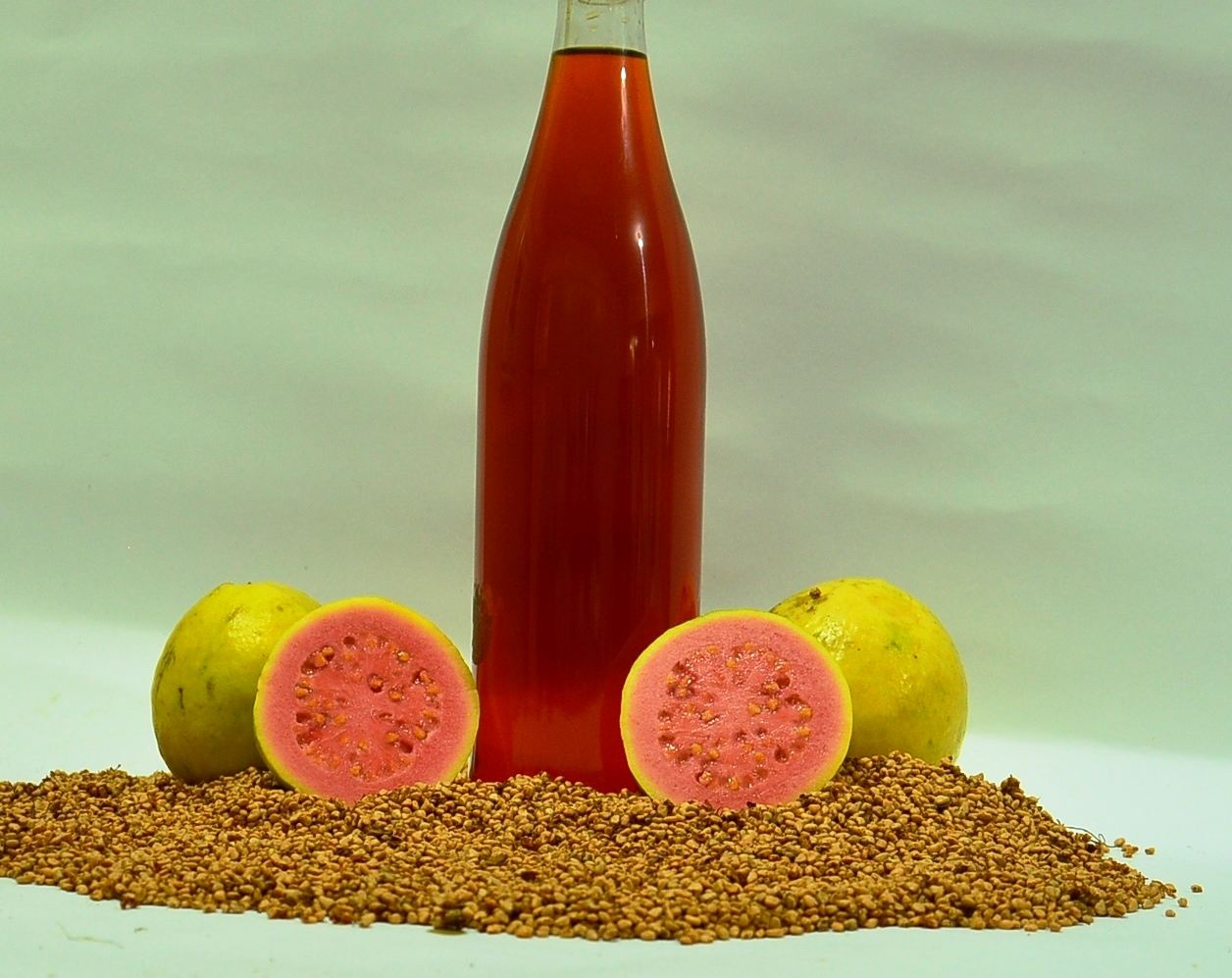 Guava — Product (seed oil)Guava — Tree
 Guava — Leaves
 Guava — Flowers
 Guava — Ripe fruits on tree
 Guava — Fruit with sliceGuava — Product (seed oil)Guava — Tree
Overview
A small evergreen tree 3–10 m tall with flaking brown bark and softly hairy young shoots. The leaves are opposite, simple and entire, elliptic to ovate, 5–15 cm long, dark glossy above and hairy beneath with prominent veins. The short-stalked flowers occur singly or in twos or threes in the leaf axils; they have five white petals and very many yellow stamens, are lightly fragrant and insect-pollinated. The fruit is a berry, globose to ovoid, 4–12 cm across; the skin is green ripening to yellow-green or yellow; the flesh is white, pale yellow or pink-red depending on the cultivar, sweet and aromatic; the core holds many small hard kidney-shaped seeds. Common cultivars include 'Nữ hoàng', 'Xá lị' and seedless types grown largely in the Mekong Delta.
Guava is native to Mexico, Central America, the Caribbean and northern South America; the Spanish spread it across the tropics from the 16th century (the name derives from Taíno 'guayabo'). World output of guavas (combined with mangoes and mangosteens in statistics) is some 55–62 million tonnes (2019–2024), led by India with about 45%. Guava is exceptionally rich in vitamin C (about four times as much as oranges), soluble fibre, potassium and lycopene (in pink-fleshed types), supporting digestion and immunity. In Vietnam guava is grown throughout the country; famous areas include Phú Thọ (VietGAP guavas), the Mekong Delta (Tiền Giang, Cần Thơ — pear and seedless types) and Lâm Đồng. Folk practice uses guava-leaf decoctions for bathing and for diarrhoea; the fruit is eaten fresh, juiced, blended, made into jam, and served as 'ổi lắc' (shaken guava with chilli salt).
Life cycle
From seed to productYoung tree
Fast-growing; seedlings exceed 1 m within 14 months and tolerate poor soils.
Mature tree
A small tree 3–10 m tall with peeling bark and a spreading crown.
Flowering
White five-petalled flowers with many yellow stamens, borne singly or in pairs in leaf axils.
Ripe fruit
A berry ripening from green to yellow-green, with white to pink fragrant flesh.
Distribution & origin
Share of recorded occurrences by region- Mexico, Central America, Caribbean, northern South America (origin)15%
- India & South Asia (largest producer)35%
- Southeast Asia (Vietnam, Thailand, Indonesia)30%
- Africa · other tropical America · Oceania20%
Chemical composition
Relative content in agarwood resin- WaterFresh juicy flesh81%
- Carbohydrate (sugars)Natural sweetness13%
- Dietary fibreSupports digestion4.5%
- ProteinModerate content0.9%
- FatLow, mostly in seeds0.4%
- Vitamins & minerals (C, K, potassium, lycopene)Very high vitamin C; antioxidants0.2%
Uses
- Eaten fresh, juiced, blended; 'ổi lắc' with chilli salt; guava jam, ice cream and pastries
- Guava leaves boiled for bathing and a folk decoction against diarrhoea; guava-leaf tea
- Guava seed oil used in cosmetics and skin care
- Wood for small implements and handles; planted for hedges and shade
Properties
- Stem
- Small tree 3–10 m, flaking bark
- Leaf
- Opposite, simple, prominent veins, hairy beneath
- Flower
- White, 5 petals, many stamens
- Fruit
- Berry, green-yellow skin, sweet fragrant flesh
Habitat & conservation
A tropical and subtropical crop preferring full sun; drought-tolerant and not demanding of soil (best in loose, well-drained soil at pH 5–7). In Vietnam it bears 2–4 crops a year; major areas: Phú Thọ, Tiền Giang, Cần Thơ, Vĩnh Long and Lâm Đồng.
Conservation
Not Evaluated on the IUCN Red List. Widely cultivated; local cultivars are conserved in home gardens.
References
- 1Plants of the World Online — Psidium guajava L. — Kew Science, 2026
- 2Guava — mô tả, từ nguyên, sản xuất — English Wikipedia, 2026
- 3Ổi — đặc điểm, phân loại, trồng trọt — Vietnamese Wikipedia, 2026
- 4FAOSTAT — Crops: guavas, mangoes, mangosteens (sản lượng toàn cầu) — FAO, 2024
- 5Nguồn ảnh: David J. Stang / Gabriel Collares / Ton Rulkens (CC BY-SA 4.0 / CC BY 4.0 / CC BY-SA 2.0) — Wikimedia Commons,
- 6Nguồn ảnh: Forest & Kim Starr / Ivar Leidus / P. S. Sena (CC BY 3.0 / CC BY-SA 4.0) — Wikimedia Commons,