
Oil palm
Elaeis guineensis Jacq.
Oil palm (Elaeis guineensis) is a palm yielding the world's two most important vegetable oils — palm oil from the fruit flesh and palm kernel oil from the seed; widely planted in Indonesia and Malaysia.
No ratings yet — be the first!
Gallery
 Oil palm — Palm oilOil palm — Tree
 Oil palm — Tree with bunch
 Oil palm — Plantation
 Oil palm — Fruit bunch
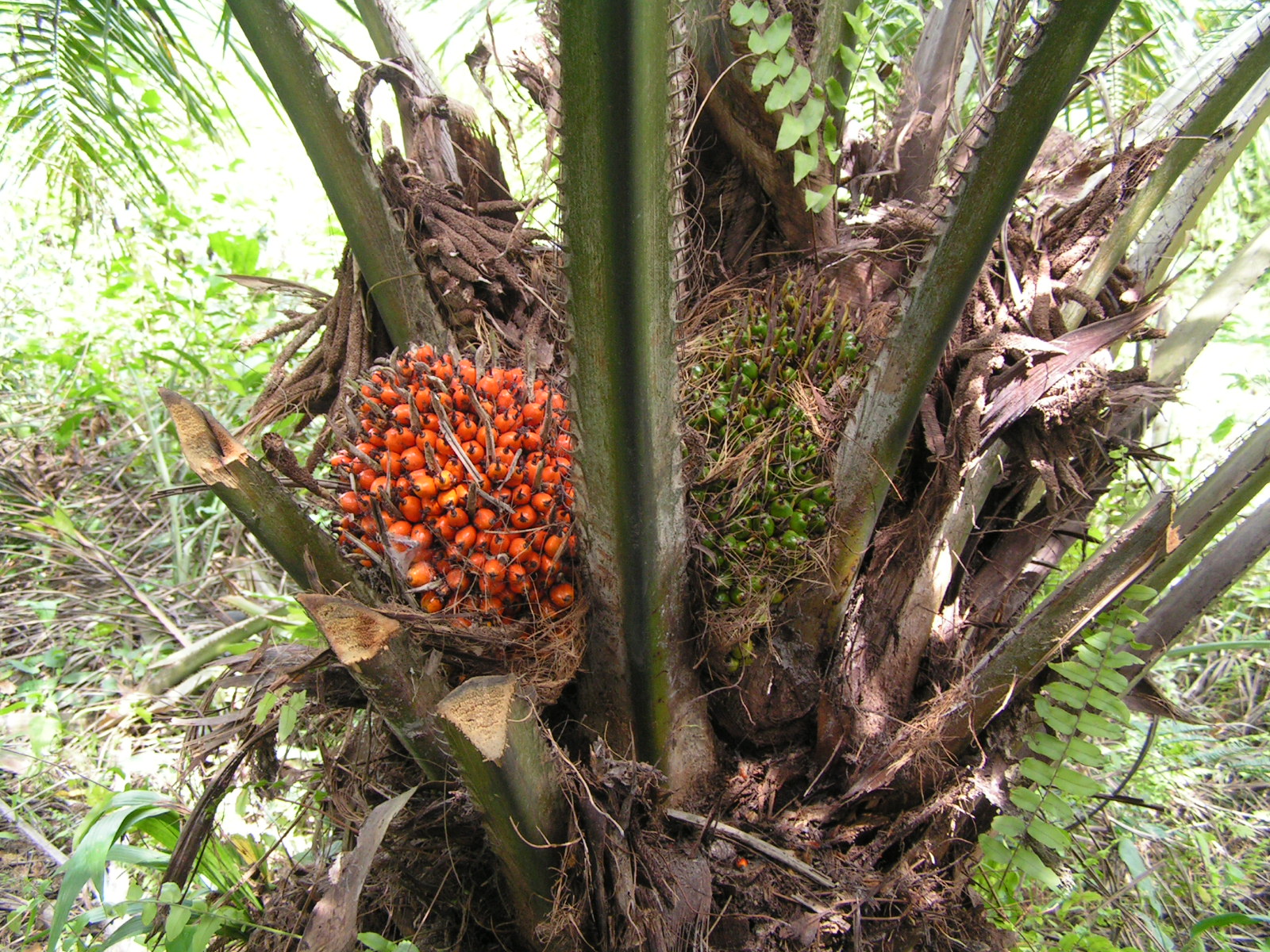 Oil palm — FruitOil palm — Palm oilOil palm — Tree
Overview
Oil palm (Elaeis guineensis), also called African oil palm, is a palm of the palm family (Arecaceae) native to West and Central Africa and now widely planted throughout the tropics. It has a single stem 20–30 m tall and 30–50 cm thick that lives 25–30 years; its pinnate leaves, 3–5 m long, form a crown and have spiny petioles. The tree is monoecious, with male and female inflorescences borne separately on the same plant, pollinated by wind and insects. The fruit is a drupe 3–5 cm long arranged in bunches weighing 10–25 kg; the fruit flesh is pressed for palm oil while the kernel yields palm kernel oil. It is the world's most important oil-producing crop, accounting for much of global vegetable oil output, concentrated in Indonesia and Malaysia.
The oil palm is among the most important industrial oil crops: red palm oil pressed from the fruit flesh is used in cooking and is rich in carotene (pro-vitamin A) and tocotrienol vitamin E; palm kernel oil is used in margarine, confectionery, cosmetics, soap, candles, biodiesel and oleochemicals. The press cake provides animal feed, empty fruit bunches become organic fertiliser and biomass fuel, and flower sap is fermented into palm wine. The palm prefers a hot, humid tropical climate with 1500–3000 mm of rain a year, below 500 m, on well-drained, fertile soils; it is propagated by seed (commonly the Tenera hybrid) and starts fruiting after 3–4 years. Oil palm expansion has major impacts on tropical forests.
Life cycle
From seed to productTree
https://thumb.wikimedia.org/wikipedia/commons/thumb/5/51/Elaeis_guineensis_2.jpg/1920px-Elaeis_guineensis_2.jpg
Tree with bunch
https://thumb.wikimedia.org/wikipedia/commons/thumb/8/86/Oil_Palm_Tree_with_Fruit_Bunch_%28Elaeis_guineensis%29.jpg/1920px-Oil_Palm_Tree_with_Fruit_Bunch_%28Elaeis_guineensis%29.jpg
Fruit bunch
https://thumb.wikimedia.org/wikipedia/commons/thumb/f/f1/Oil_Palm_Fruit_Bunch.jpg/1920px-Oil_Palm_Fruit_Bunch.jpg
Palm oil
https://thumb.wikimedia.org/wikipedia/commons/thumb/f/fe/Local_Palm_oil_production_Ondo_state.jpg/1920px-Local_Palm_oil_production_Ondo_state.jpg
Distribution & origin
Share of recorded occurrences by region- Indonesia40%
- Malaysia30%
- Nigeria & West Africa15%
- Thailand & other Asia10%
- Tropical America5%
Chemical composition
Relative content in agarwood resin- Oil50%
- Water40%
- Protein4%
- Minerals & vitaminsCarotene, vitamin E3%
- Fibre2%
- Others1%
Uses
- Food: red palm oil for cooking; palm kernel oil in margarine, confectionery
- Industry: soap, cosmetics, candles, biodiesel, oleochemicals
- Health & nutrition: red palm oil rich in carotene (vitamin A) and tocotrienol vitamin E
- Other: press cake as animal feed; fruit bunches as fertiliser/fuel; flower sap as palm wine
Properties
- Form
- Large palm, single stem
- Fruit
- Oil-rich; orange-red skin
- Nature
- Neutral
- Actions
- Palm oil rich in carotene (vitamin A) and vitamin E, energy source
Habitat & conservation
Oil palm prefers a hot, humid tropical climate with 1500–3000 mm annual rainfall, growing below 500 m on well-drained, fertile soils. It is propagated by seed, commonly the Tenera hybrid; it begins fruiting after 3–4 years and gives high yields for 20–25 years. In Vietnam it has been trial-planted in some southern provinces but is not widespread.
Conservation
Listed as Least Concern (LC) by IUCN; widespread and planted throughout the tropics. Palm family (Arecaceae), genus Elaeis.
References
- 1Plants of the World Online — Elaeis guineensis Jacq. — Kew Science, 2026
- 2Oil palm — mô tả, phân bố, sản phẩm — Wikipedia tiếng Anh, 2026
- 3Cọ dầu — đặc điểm, dầu cọ, công dụng — Wikipedia tiếng Việt, 2026
- 4油棕 Elaeis guineensis — 形態、用途 — Wikipedia tiếng Trung, 2026
- 5Nguồn ảnh: Akouete (CC BY-SA 4.0) / Johnnybam (CC BY-SA 4.0) / Wee Hong (CC BY-SA 4.0) — Wikimedia Commons,
- 6Nguồn ảnh: Geossegawa (CC BY 4.0) / Bongoman (CC BY-SA 3.0) / Ei'eke (CC BY-SA 4.0) — Wikimedia Commons,