

Water spinach
Ipomoea aquatica Forssk.
Water spinach (Ipomoea aquatica Forssk.) is a semi-aquatic herb of the morning glory family (Convolvulaceae), trailing or floating on water thanks to its hollow, node-rooting stems. It is one of the most widely eaten leafy vegetables in Southeast Asia, with two main forms: the white form (usually grown on land) and the purple/field form (usually grown or naturalised in water). Young shoots and leaves are stir-fried with garlic, boiled or used in soups; according to Kew POWO its native range spans the tropical and subtropical Old World to Australia, and it has naturalised elsewhere.
No ratings yet — be the first!
Gallery
 Water spinach — Stir-fried dishWater spinach — Plant (on land)
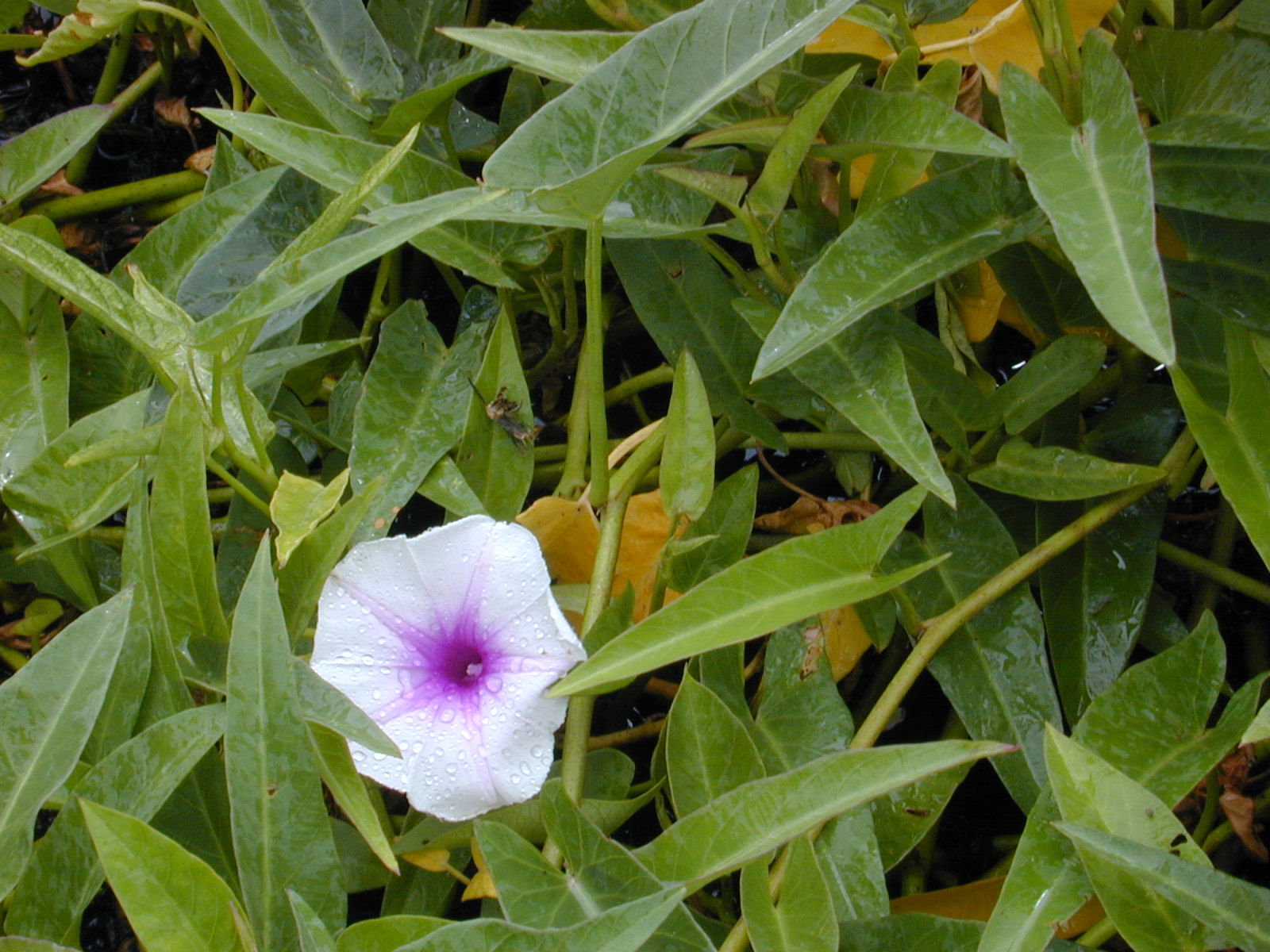 Water spinach — Leaves & flower
 Water spinach — White flower
 Water spinach — Flower
 Water spinach — Growing bedsWater spinach — Stir-fried dishWater spinach — Plant (on land)
Overview
A semi-aquatic trailing herb, sprawling on the water surface or spreading on land. The stem is hollow, fleshy, with milky sap, 2–3 m long, rooting at the nodes where it touches mud or water, which keeps the plant afloat and promotes branching. Leaves are alternate, the blade varying from arrowhead-shaped (sagittate) to lanceolate or hastate, 5–15 (to about 17) cm long with petioles 3–14 cm, surfaces glabrous. Flowers are funnel-shaped, 3–5 cm across, usually white with a pale purple throat, borne singly or one to two per stalk. The round capsule is about 7–9 mm across, four-loculed, holding four rusty, hairy seeds.
According to Plants of the World Online (Kew), Ipomoea aquatica Forssk. has the native range "Tropics & Subtropical Old World to Australia", that is the tropical and subtropical Old World (tropical Asia, tropical Africa) extending to Australia; its native habitats include swamps, ponds, ditches and seasonally flooded fields. The species was widely domesticated and popularised in Southeast Asia (considered the domestication centre), South Asia and East Asia, and has naturalised in tropical America. In Florida (USA) it is on the Federal Noxious Weed List and ranked FISC Category 1 Invasive; in Queensland (Australia) it is also managed as an aquatic invader. In Vietnam it is grown and occurs throughout the lowlands, harvested year-round in warm areas.
Chemically, the main constituent is water (about 92% fresh weight), alongside protein around 3.2%, carbohydrates 2.5–4.4%, fibre about 1.5% and ash. Water spinach is rich in beta-carotene (provitamin A), vitamin C and folate together with the minerals calcium, iron, potassium, magnesium and phosphorus. Its main biologically active group is total phenolics and flavonoids; a 2020 review placed water spinach among the top three aquatic leaf vegetables for antioxidant capacity. Freeze-dried water-spinach powder was reported to have a total phenolic content of about 32 µg/mL and antioxidant activity of 77.25% (2021 study). In polluted water the plant tends to accumulate nitrates and heavy metals, while its leaves are rich in oxalates.
On nutrition and uses, Saikia and colleagues (2023, Frontiers in Nutrition) showed Ipomoea aquatica is rich in minerals, dietary fibre and essential amino acids; Cha and colleagues (2023) compared processing methods and found quick stir-frying retained more antioxidant activity than boiling or wilting. Culinary use in Southeast Asia centres on young shoots stir-fried with garlic, boiled or simmered in soups (notably crab and water-spinach soup in Vietnam), and the plant is also a cheap livestock feed using both stems and leaves. In regional folk medicine it is used as a cooling vegetable, a mild laxative and a source of micronutrients, although most therapeutic evidence remains at in-vitro or animal-study level.
On safety, never eat water spinach raw if it grows in polluted water or is fertilised with fresh manure: larvae of liver flukes (Clonorchis/Opisthorchis), lung flukes (Paragonimus) and roundworms can adhere to the leaves, so it must be washed and thoroughly cooked. People prone to kidney stones should limit heavy consumption because the leaves are rich in oxalates; since the plant accumulates nitrates and heavy metals in dirty water, it should only be eaten when grown in clean water sources. On conservation, the IUCN Red List has not evaluated this species (NE); overall it is not threatened because it is widely cultivated across the tropics, but in some temperate and subtropical regions (Florida, Queensland) it is managed as an aquatic invasive.
Life cycle
From seed to productCutting & growth
Stem cuttings are planted in mud or moist soil; the hollow stems quickly sprawl and root at the nodes.
Plant & leaves
Hollow stems trail 2–3 m; leaves range from arrowhead-shaped to lanceolate with pointed tips.
Flowering
Funnel-shaped flowers 3–5 cm, white with a pale purple centre, one or two per stalk.
Harvest
Young shoots are picked 30–45 days after planting; water beds give many cuttings year-round in warm regions.
Distribution & origin
Share of recorded occurrences by region- Tropical Asia (Southeast, South, East Asia) — domesticated & grown40%
- Tropical Africa (native & cultivated)25%
- Tropical Americas (grown & naturalised; invasive in Florida)15%
- Oceania (Australia — native; controlled as invasive in Queensland)10%
- Europe & temperate regions (limited greenhouse growing)10%
Chemical composition
Relative content in agarwood resin- WaterMain component, ~92% of fresh weight55%
- CarbohydrateAbout 2.5–4.4% fresh weight, incl. natural sugars15%
- Protein~3.2% fresh weight; rich in essential amino acids (Saikia et al., 2023)12%
- Dietary fibre~1.5% fresh weight, mainly cellulose and hemicellulose8%
- Minerals (Ca, Fe, K, Mg, P)Notable calcium, iron, potassium, magnesium, phosphorus6%
- Vitamins & phenolicsBeta-carotene (provitamin A), C, folate; antioxidant total phenolics & flavonoids4%
Uses
- Food: young shoots and leaves stir-fried with garlic, boiled or in soups — famous as crab and water-spinach soup in Vietnam and in stir-fries and sour soups across Southeast Asia
- A common, cheap vegetable harvested continuously; grown both on land (kept moist) and in flooded beds or ponds
- Cheap livestock feed using stems, leaves and shoots
- Nutrition & medicine: supplies beta-carotene (provitamin A), vitamin C and minerals; used in folk medicine as a cooling vegetable and mild laxative
- Research application: freeze-dried water-spinach powder as a functional-food ingredient, rich in phenolics with high antioxidant activity
Properties
- Stem
- Hollow, thick, trailing on water or land, rooting at nodes
- Leaf
- Arrowhead-shaped, pointed, alternate
- Flower
- Funnel-shaped, white/purple
- Fruit
- Round capsule with four rusty-hairy seeds
Habitat & conservation
A tropical and subtropical semi-aquatic species; its native habitats include swamps, ponds, ditches, slow streams and seasonally flooded fields (POWO: climbing helophyte of seasonally dry tropics). It favours abundant water and sun and can be grown on land if kept moist. It thrives year-round in warm areas, roots quickly at stem nodes and can be harvested 30–45 days after planting cuttings.
Conservation
Not Evaluated on the IUCN Red List (NE). Overall it is not threatened because it is widely cultivated across the tropics and subtropics and propagates quickly from cuttings. However, in Florida (USA) it is on the Federal Noxious Weed List and ranked FISC Category 1 Invasive, and in Queensland (Australia) it is managed as an aquatic invader — cultivation areas should be managed to prevent escape into the wild.
References
- 1Plants of the World Online — Ipomoea aquatica Forssk. (native range: Trop & Subtropical Old World to Australia) — Kew Science, 2026
- 2Chemical and biochemical characterization of Ipomoea aquatica (water spinach): minerals, dietary fiber and essential amino acids — Frontiers in Nutrition (Saikia et al.), 2023
- 3Quality and Antioxidant Characteristics of Water Spinach (Ipomoea aquatica) under various cooking methods — AGRIS / FAO (Cha et al.), 2023
- 4Development of water spinach powder and its characterization (TPC ~32 µg/mL, antioxidant 77.25%) — PMC / NCBI, 2021
- 5Comparative assessment of bioactive compounds and antioxidant activity in Ipomoea aquatica — ScienceDirect (Hossain et al.), 2021
- 6Ipomoea aquatica — Federal Noxious Weed List, FISC Category 1 Invasive, nonnative to Florida — University of Florida IFAS — Center for Aquatic and Invasive Plants, 2026
- 7Ipomoea aquatica (water spinach) — taxonomy, distribution, cultivation and uses — Wikipedia (English), 2026
- 8Rau muống — đặc điểm, thành phần dinh dưỡng, cách trồng và lưu ý an toàn — Vietnamese Wikipedia, 2026
- 9FAO/WHO — parasite (liver fluke, lung fluke) transmission risk from raw aquatic leafy vegetables — FAO / WHO food-safety guidance, 2024
- 10Nguồn ảnh: Prenn (CC BY-SA 3.0) — Wikimedia Commons,
- 11Nguồn ảnh: Eric Guinther (CC BY-SA 3.0) — Wikimedia Commons,
- 12Nguồn ảnh: Vitaium / Dwi arinto (CC BY-SA 4.0) — Wikimedia Commons,
- 13Nguồn ảnh: Sudzie (CC BY-SA 4.0) — Wikimedia Commons,
- 14Nguồn ảnh: NeoBatfreak (CC BY-SA 4.0) — Wikimedia Commons,
- 15Nguồn ảnh: Wee Hong (CC BY-SA 4.0) — Wikimedia Commons,