
Soybean
Glycine max (L.) Merr.
The soybean (Glycine max) is a legume rich in protein and oil; its seeds feed people and livestock, and its roots host nitrogen-fixing Rhizobium bacteria that improve the soil.
No ratings yet — be the first!
Gallery
 Soybean — SeedsSoybean — Plant
 Soybean — Plant & leaves
 Soybean — Flower
 Soybean — Flower cluster
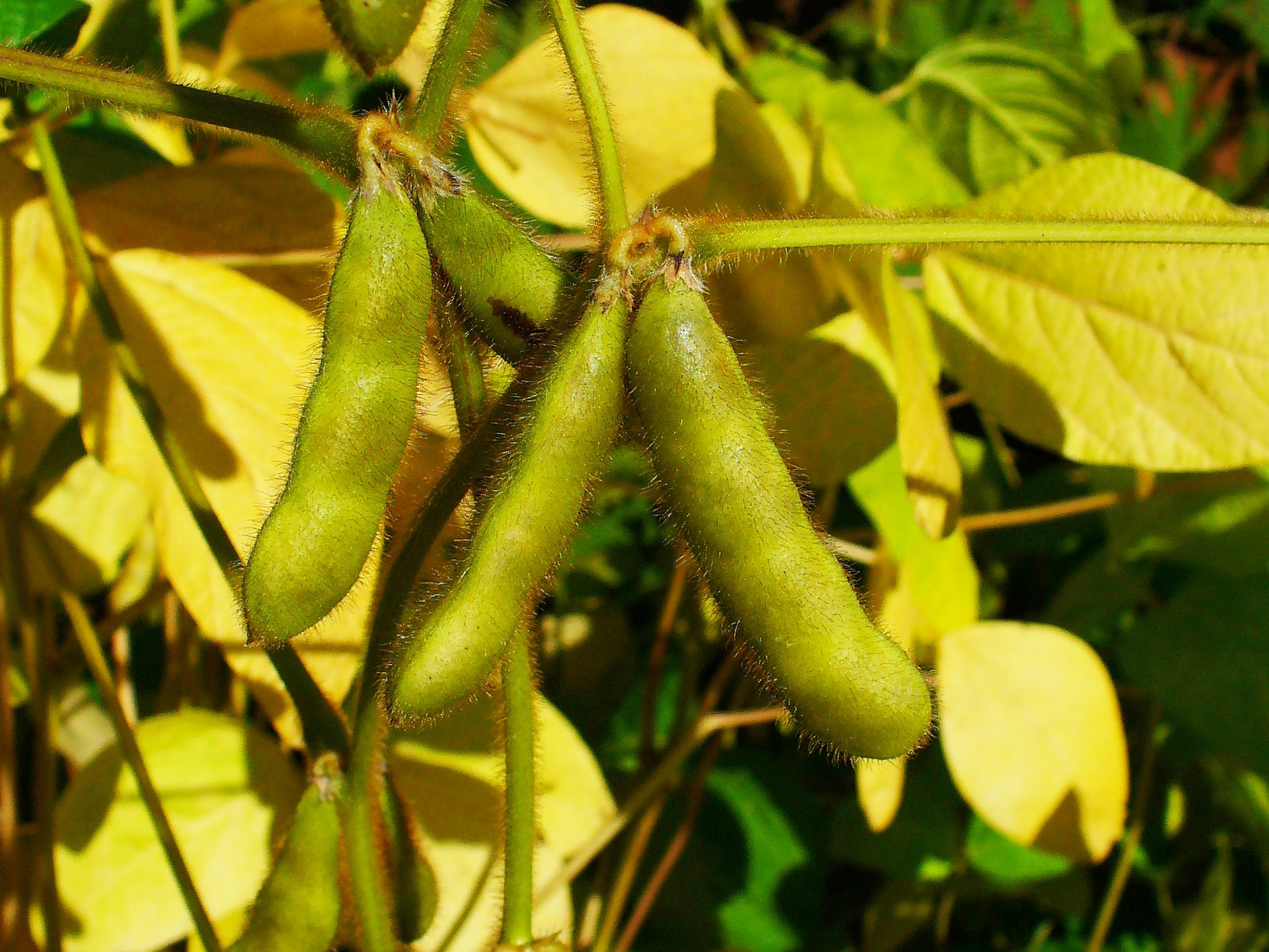 Soybean — Pods & seedsSoybean — SeedsSoybean — Plant
Overview
An annual herb, 0.2–2 m tall, with an erect branching stem. Leaves are trifoliate. The small pea-like flowers are white or pale purple in axillary racemes. The fruit is a hairy legume pod with 2–4 round seeds. The roots bear nodules formed by symbiotic Rhizobium bacteria that fix atmospheric nitrogen.
The soybean is native to East Asia and was domesticated in China thousands of years ago before spreading worldwide. The seed contains about 36–40% protein and 20% oil, making it the most important oil- and protein-producing crop. From the seeds are made tofu, soy milk, soy sauce, fermented pastes, yuba and cooking oil; the meal feeds livestock. Thanks to biological nitrogen fixation, soybean is also used in rotation to improve soil.
Life cycle
From seed to productGermination
Soybean seeds germinate in moist soil; the radicle grows down and the shoot grows up.
Seedling & leaves
The plant grows as an erect bush; leaves are hairy and trifoliate.
Flowering
Small pea-like flowers, white or pale purple, in axillary racemes.
Pods & ripe seeds
The hairy pod holds 2–4 seeds; on ripening the pod turns brown and the seeds harden.
Distribution & origin
Share of recorded occurrences by region- East Asia (origin, China)30%
- Asia (long cultivated)20%
- Americas (USA, Brazil, Argentina — major output)30%
- Grown worldwide (incl. Vietnam)20%
Chemical composition
Relative content in agarwood resin- ProteinHigh plant protein content40%
- CarbohydrateIncluding fibre and oligosaccharides25%
- Oil (lipid)Rich in unsaturated fatty acids20%
- IsoflavonesPhytoestrogens (genistein, daidzein)8%
- Vitamins & minerals (K, Fe, Ca)Potassium, iron, calcium, B vitamins7%
Uses
- Food: tofu, soy milk, soy sauce, fermented pastes, yuba, okara, boiled edamame
- Soybean oil for cooking and industry; the meal feeds livestock
- Rotation to improve soil via nitrogen fixation; in Vietnam grown in two seasons
- Green industry: biodiesel, printing ink, bioplastics from soybean oil
Properties
- Stem
- Erect branching herb, 0.2–2 m tall
- Leaf
- Trifoliate compound leaf, finely hairy
- Flower
- Pea-like (papilionaceous), white/pale purple
- Fruit
- Hairy legume pod with 2–4 seeds
- Root
- Nodules with nitrogen-fixing bacteria
Habitat & conservation
Native to East Asia; an annual favouring warm climates, loose well-drained soil and long days. In Vietnam it is sown mainly in the spring and summer–autumn seasons, often in rotation with rice in the lowlands and midlands.
Conservation
Not Evaluated on the IUCN Red List. The soybean is a global staple crop whose germplasm is conserved in many international genebanks, so it is not threatened.
References
- 1Plants of the World Online — Glycine max (L.) Merr. — Kew Science, 2026
- 2Soybean (Glycine max) — nguồn gốc, phân loại, sử dụng — English Wikipedia, 2026
- 3Đậu nành — đặc điểm, giá trị dinh dưỡng, chế biến — Vietnamese Wikipedia, 2026
- 4FAOSTAT — Crops and livestock products (soybean) — FAO, 2024
- 5Nguồn ảnh: H. Zell (CC BY-SA 3.0) — Wikimedia Commons,
- 6Nguồn ảnh: Krzysztof Ziarnek, Kenra (CC BY-SA 4.0) — Wikimedia Commons,
- 7Nguồn ảnh: Ayotte, Gilles (CC BY-SA 4.0) — Wikimedia Commons,
- 8Nguồn ảnh: Harry Rose (CC BY 2.0) — Wikimedia Commons,
- 9Nguồn ảnh: USDA (Public domain) — Wikimedia Commons,