

Tetrapanax papyrifer
Tetrapanax papyrifer (Hook.) K.Koch
Tetrapanax papyrifer, the rice paper plant (通草—tong cao), is an evergreen shrub or small tree in the family Araliaceae, the sole species in the genus Tetrapanax.
No ratings yet — be the first!
Gallery
 Tetrapanax papyrifer plantTetrapanax papyrifer
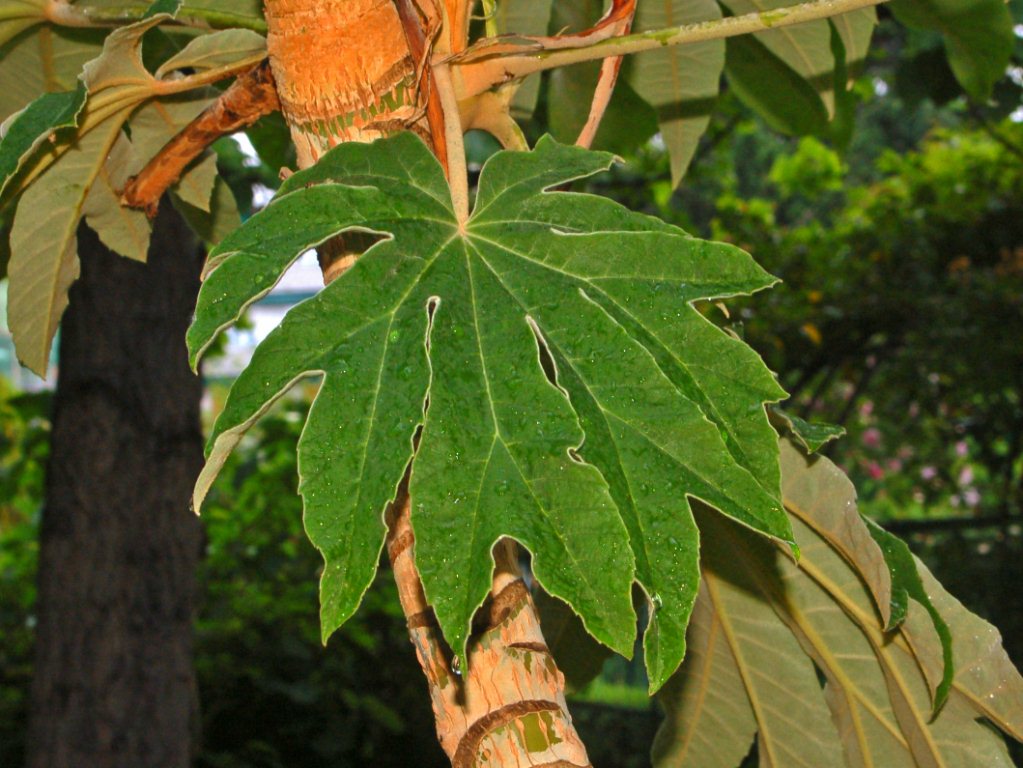 Tetrapanax papyrifer
 Tetrapanax papyrifer
 Tetrapanax papyrifer
 Tetrapanax papyrifer
 Tetrapanax papyrifer plantTetrapanax papyrifer plantTetrapanax papyrifer
Overview
Tetrapanax papyrifer, the rice paper plant (通草—tong cao), is an evergreen shrub or small tree in the family Araliaceae, the sole species in the genus Tetrapanax. The specific epithet is frequently misspelled as "papyriferum", "papyriferus", or "papyrifera". It is native to eastern and central China and Taiwan, but widely cultivated in East Asia and in other tropical to mild temperate regions as well.
Updated by lebachungtdh@gmail.com · 10/15/2026
The species was first described in the genus Aralia as Aralia papyrifera, and has also been treated in Fatsia as Fatsia papyrifera.
Updated by lebachungtdh@gmail.com · 10/15/2026
A second species, Tetrapanax tibetanus, is now regarded as a synonym of Merrilliopanax alpinus.
Updated by lebachungtdh@gmail.com · 10/15/2026
Uses
- The species was first described in the genus Aralia as Aralia papyrifera, and has also been treated in Fatsia as Fatsia papyrifera.
Habitat & conservation
It is native to eastern and central China and Taiwan, but widely cultivated in East Asia and in other tropical to mild temperate regions as well.
Conservation
Tetrapanax papyrifer has not been assessed by the IUCN Red List (NE). As a medicinal plant, it benefits from sustainable collection and propagation to protect wild genetic resources.
References
- 1Wikipedia – Tetrapanax papyrifer — Wikipedia,
- 2Kew POWO – Tetrapanax papyrifer — Plants of the World Online (Kew),
- 3Wikidata – Q8085880 — Wikidata,