Turmeric
Curcuma longa L.
Turmeric (Curcuma longa) is the most widely cultivated member of the ginger family; its orange rhizome holds 2–5% curcuminoids — both a spice and food colour and one of the most clinically studied medicinal plants.
No ratings yet — be the first!
Gallery
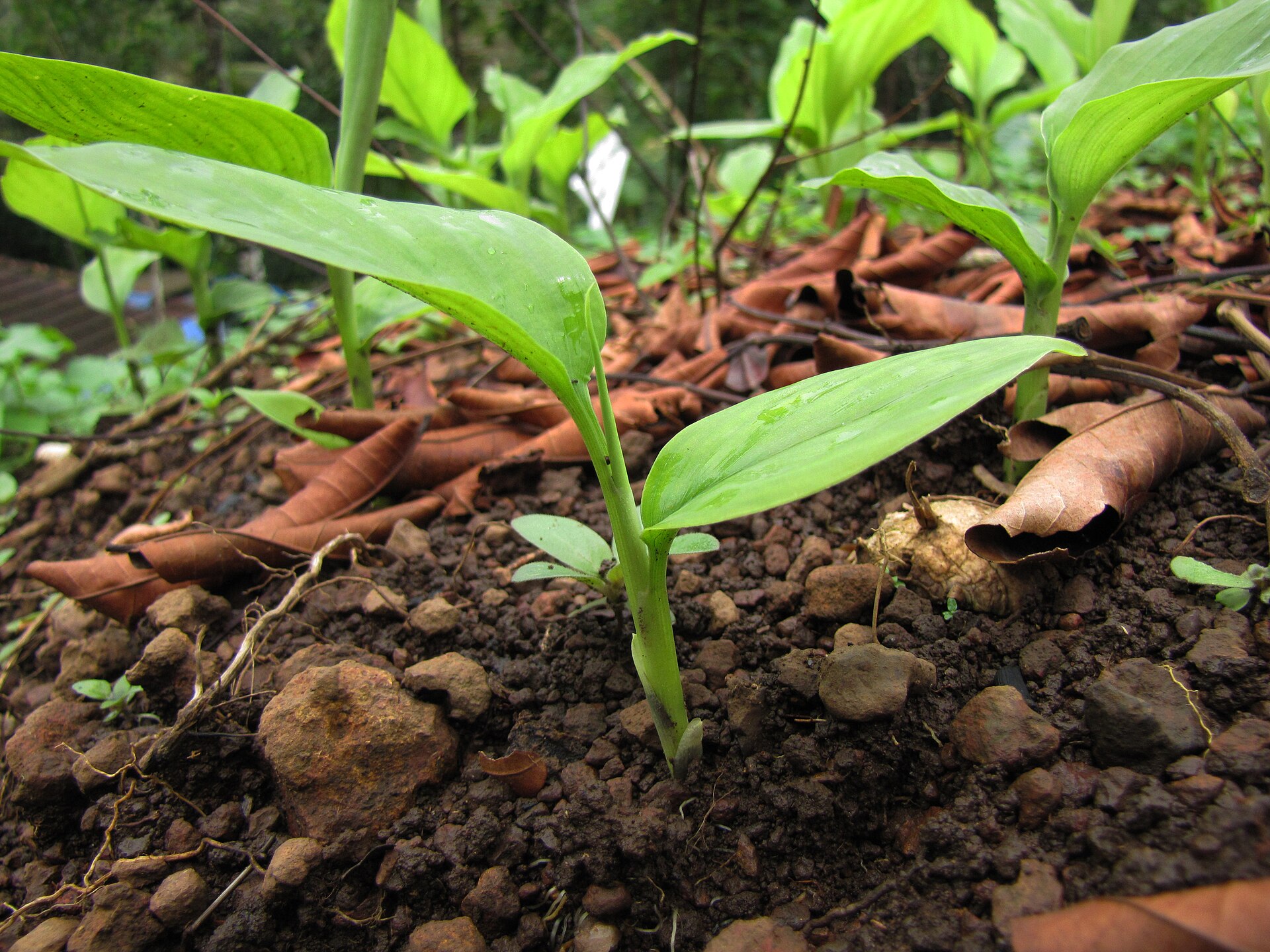
 Turmeric (Curcuma longa)Shaded turmeric patch
 Turmeric (Curcuma longa)Turmeric (Curcuma longa)Shaded turmeric patch
Photo credits: Vaikoovery (CC BY 3.0)
Overview
Turmeric (Curcuma longa) is a perennial rhizomatous herb 0.6–1.5 m tall in the ginger family (Zingiberaceae). Its oblong-lanceolate leaves, 30–45 cm long, rise in rows from a pseudostem, and small pale-yellow flowers form a cylindrical spike in the leaf axils. The harvested part is the orange rhizome, a branching underground stem whose colour comes from curcuminoids. The plant grows vigorously in the rainy season and dies back to a dormant rhizome in the dry season, favouring a tropical climate of 20–30 °C with 1,500–2,500 mm of rain per year.
According to Plants of the World Online (Kew), turmeric is treated as a cultigen originating in southwestern India and now spread throughout the tropics and subtropics. India dominates with roughly 75–80% of world output, mainly in Andhra Pradesh, Telangana, Tamil Nadu and Karnataka; other significant producers include Bangladesh, China, Indonesia, Thailand, Myanmar, Nigeria and Vietnam. Turmeric prefers loose, organic-rich, well-drained sandy loam and cannot tolerate waterlogging.
The main active constituents are curcuminoids, making up 2–5% of the dried rhizome: curcumin (about 60–70% of total curcuminoids), demethoxycurcumin and bisdemethoxycurcumin — the trio responsible for the yellow colour and the antioxidant and anti-inflammatory activity. The essential oil accounts for 1–3% and is rich in sesquiterpenes such as ar-turmerone, α- and β-turmerone and zingiberene, which give the warm aroma. The rhizome also contains starch, polysaccharides, fibre and minor phenolics. Curcumin is fat-soluble but almost insoluble in water and is rapidly metabolised, so its oral bioavailability is very low.
Turmeric is both the colouring spice of curry powder and many Asian dishes and a medicine of Ayurveda and traditional Chinese medicine used for millennia. Curcumin has been studied extensively: a meta-analysis of randomised controlled trials (Ferguson et al., 2024) found that curcumin supplementation lowered the inflammatory markers CRP, IL-6 and TNF-α and improved endothelial function, while a GRADE-assessed dose–response meta-analysis (Dehzad et al., Cytokine, 2023) reported antioxidant and anti-inflammatory effects. A review by Kunnumakkara et al. (ACS Pharmacology & Translational Science, 2023) compiled more than 400 clinical studies of curcumin in chronic disease. Because absorption is poor, newer formulations (phytosome, nanoparticles, piperine combinations) have been developed to raise bioavailability (Hegde et al., ACS Omega, 2023).
At culinary doses turmeric is considered safe; high supplemental doses may cause digestive upset and rare reports of liver injury, so caution is advised with anticoagulants or before surgery. For conservation, Curcuma longa was assessed as Data Deficient (DD) by the IUCN in 2021 and is predicted not to be threatened with extinction (Bachman et al., 2024); as a globally cultivated crop, conservation priorities centre on maintaining local landraces and wild genetic resources in its area of origin.
Life cycle
From seed to productSeed rhizome
Turmeric is propagated mainly from seed rhizomes: the rhizome is cut into pieces of 2–3 nodes, the cut faces are callused, then planted in warm, moist soil.
Sprouting
The rhizome eyes sprout after 1–2 weeks; rolled leaves rise and gradually open while roots develop around the piece.
Seedling
New shoots grow into leafy clumps; at this early stage the plant is moisture-loving and grows well in light shade.
Mature plant
Plants reach 0.6–1 m with deep green leaves; over the first 4–6 months the underground rhizomes expand and accumulate curcuminoids.
Rhizome ripening
After 8–10 months the leaves yellow and dry; curcuminoid content in the rhizomes peaks at the end of the season, when they are ready to lift.
Harvest
Rhizomes are dug up, washed and sorted, then boiled or dried and milled into turmeric powder; volatile oil and oleoresin may be separated by solvent extraction.
Distribution & origin
Share of recorded occurrences by region- India52%
- Indonesia · Thailand · Myanmar18%
- China13%
- Vietnam8%
- Nigeria · Bangladesh6%
- Other regions3%
Chemical composition
Relative content in agarwood resin- CurcuminoidsCurcumin, demethoxycurcumin, bisdemethoxycurcumin — yellow pigments, main actives42%
- Essential-oil sesquiterpenesar-Turmerone, α/β-turmerone, zingiberene23%
- PolysaccharidesIncluding storage starch in the rhizome18%
- FibreCellulose and hemicellulose of the rhizome10%
- Other phenolics & organic acidsMinor co-occurring compounds7%
Uses
- Spice: turmeric powder, curry, sauces, marinades
- Natural yellow food colour (E100)
- Ayurvedic and Chinese medicine for inflammation, digestion and liver support
- Clinically researched for anti-inflammatory effects (CRP, IL-6, TNF-α)
- Textile dye and cosmetic ingredient
- Bioavailability-enhanced curcumin supplements (phytosome, nano, piperine)
Properties
- Colour
- Bright orange-yellow
- Scent & taste
- Warm, mildly pungent, slightly bitter
- Solubility
- Fat-soluble, poorly water-soluble
- Food colour number
- E100 (curcumin)
Habitat & conservation
Warm tropical climate at 20–30 °C with 1,500–2,500 mm of rain per year; loose, organic-rich, well-drained sandy loam. Moisture-loving but intolerant of waterlogging; tolerates partial shade early on and dies back to a dormant rhizome in the dry season.
Conservation
On the IUCN Red List, Curcuma longa is assessed as Data Deficient (DD, 2021); an extinction-risk prediction model (Bachman et al., 2024) places it among non-threatened species. As a globally cultivated crop it faces no extinction risk; the main conservation challenge is maintaining local landraces and wild genetic resources in its southwestern Indian centre of origin.
References
- 1Curcuma longa L. — Plants of the World Online — Kew Gardens, 2026
- 2WHO Monographs on Selected Medicinal Plants, Vol. 1 — Rhizoma Curcumae Longae — WHO, 1999
- 3Curcumin Formulations for Better Bioavailability: What We Learned from Clinical Trials — ACS Omega, 2023
- 4Anti-inflammatory effects of oral supplementation with curcumin: a systematic review and meta-analysis of randomized controlled trials — Prostaglandins & Other Lipid Mediators, 2024
- 5Role of Turmeric and Curcumin in Prevention and Treatment of Chronic Diseases: Lessons Learned from Clinical Trials — ACS Pharmacology & Translational Science, 2023
- 6Antioxidant and anti-inflammatory effects of curcumin/turmeric supplementation in adults: a GRADE-assessed systematic review and dose–response meta-analysis — Cytokine, 2023
- 7Extinction risk predictions for the world's flowering plants — Bachman et al., 2024
- 8Flora of China, Vol. 24 — Zingiberaceae — Flora of China, 2000