

Water spinach
Ipomoea aquatica Forssk.
Water spinach (Ipomoea aquatica) is a semi-aquatic morning glory grown for its tender shoots; popular in Vietnam in white and purple forms, grown both on land and in water.
No ratings yet — be the first!
Gallery
 Water spinach — Stir-fried dishWater spinach — Plant (on land)
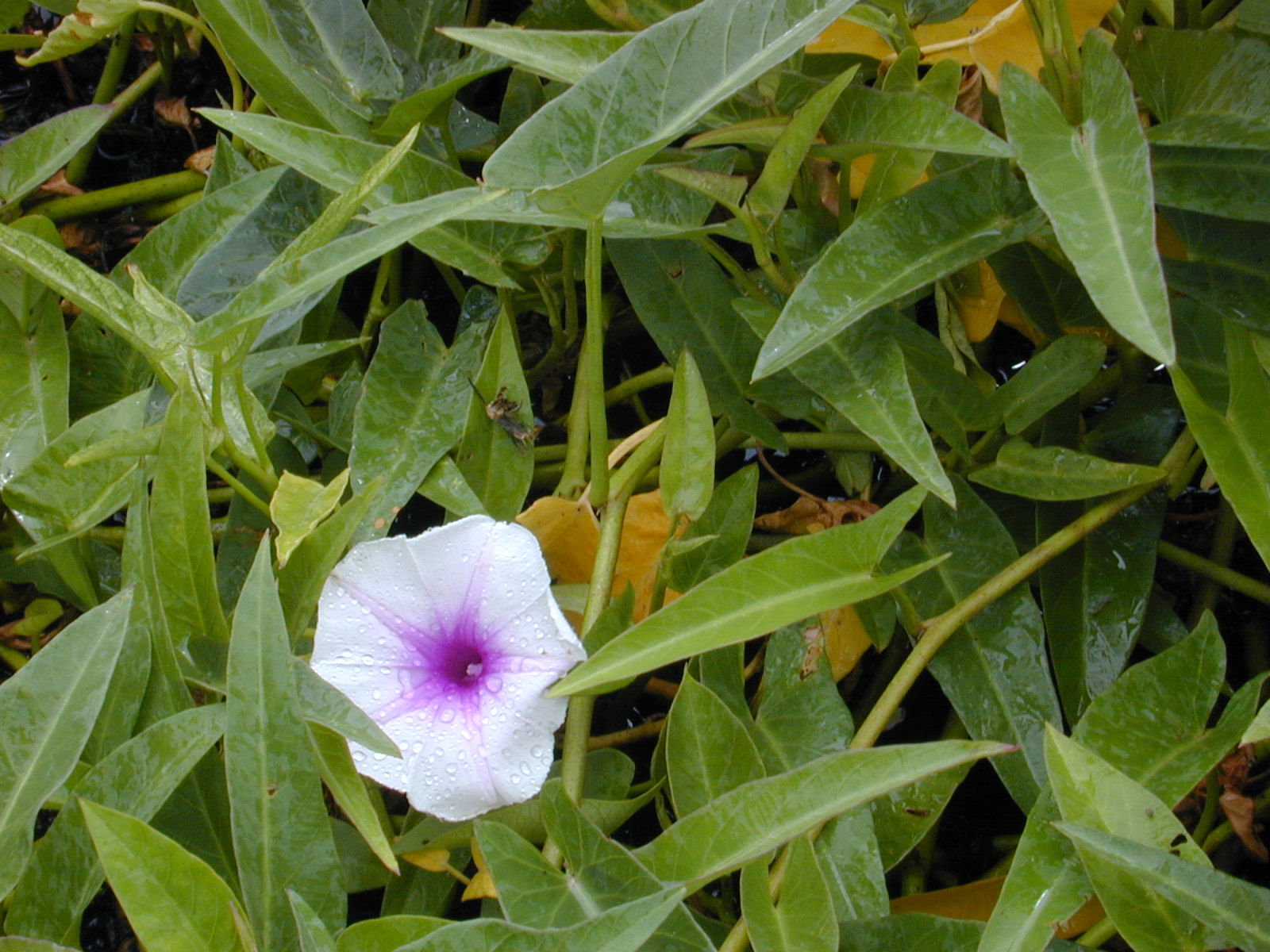 Water spinach — Leaves & flower
 Water spinach — White flower
 Water spinach — Flower
 Water spinach — Growing bedsWater spinach — Stir-fried dishWater spinach — Plant (on land)
Overview
A semi-aquatic herb trailing on water or on land. The hollow, thick stem is 2–3 m long, roots at the nodes and keeps the plant buoyant. Leaves are alternate, arrowhead-shaped (sagittate) to lanceolate, 5–15 cm long with pointed tips. The trumpet-shaped flowers are 3–5 cm across, usually white with a pale purple centre, one or two per stalk. The round capsule is 7–9 mm across and holds four rusty-hairy seeds.
Water spinach is thought to have been first domesticated in Southeast Asia and is widely cultivated across South, East and Southeast Asia. In Vietnam it is a very common vegetable: the white form is usually grown on land, while the purple form is usually grown in (or occurs naturally in) water, hence the name 'field water spinach'. The tender shoots are stir-fried with garlic, boiled or cooked in soups (such as crab and water spinach soup). The plant is high in water (about 92%), vitamins and minerals. Caution: eating it raw from polluted water can transmit parasites (worms, flukes), so it should be cooked.
Life cycle
From seed to productCutting & growth
Stem cuttings are planted in mud or moist soil; the hollow stems quickly sprawl and root at the nodes.
Plant & leaves
Hollow stems trail 2–3 m; leaves range from arrowhead-shaped to lanceolate with pointed tips.
Flowering
Funnel-shaped flowers 3–5 cm, white with a pale purple centre, one or two per stalk.
Harvest
Young shoots are picked 30–45 days after planting; water beds give many cuttings year-round in warm regions.
Distribution & origin
Share of recorded occurrences by region- Southeast Asia (domestication)30%
- South Asia · East Asia25%
- Africa · Oceania15%
- Grown across the tropics (incl. Vietnam)30%
Chemical composition
Relative content in agarwood resin- WaterMain component, about 92%60%
- Vitamins & minerals (A, C, iron, calcium)Rich in vitamin A, C, iron and calcium12%
- ProteinAbout 3.2% fresh weight10%
- Dietary fibre (cellulose)About 1% fresh weight10%
- CarbohydrateAbout 2.5% fresh weight8%
Uses
- Food: tender shoots stir-fried with garlic, boiled, or in soups; in Vietnam famous in crab soup
- A cheap, easy, continuously harvested vegetable; grown on land and in flooded beds
- Used as animal feed, using both stems and leaves
Properties
- Stem
- Hollow, thick, trailing on water or land, rooting at nodes
- Leaf
- Arrowhead-shaped, pointed, alternate
- Flower
- Funnel-shaped, white/purple
- Fruit
- Round capsule with four rusty-hairy seeds
Habitat & conservation
A tropical and subtropical semi-aquatic species; grows along ponds, canals, flooded fields and damp ground, favouring water and sun. It can be grown on land if kept moist. In Vietnam it is common in the lowlands and can be harvested year-round in warm areas.
Conservation
Not Evaluated on the IUCN Red List. Water spinach is widely cultivated across the tropics and subtropics and is not threatened; in some places it is regarded as a wetland invasive.
References
- 1Plants of the World Online — Ipomoea aquatica Forssk. — Kew Science, 2026
- 2Ipomoea aquatica (water spinach) — mô tả, phân bố, sử dụng — English Wikipedia, 2026
- 3Rau muống — đặc điểm, thành phần, cách trồng — Vietnamese Wikipedia, 2026
- 4FAO — Sử dụng và dinh dưỡng rau ăn lá nhiệt đới — FAO, 2024
- 5Nguồn ảnh: Prenn (CC BY-SA 3.0) — Wikimedia Commons,
- 6Nguồn ảnh: Eric Guinther (CC BY-SA 3.0) — Wikimedia Commons,
- 7Nguồn ảnh: Vitaium / Dwi arinto (CC BY-SA 4.0) — Wikimedia Commons,
- 8Nguồn ảnh: Sudzie (CC BY-SA 4.0) — Wikimedia Commons,
- 9Nguồn ảnh: NeoBatfreak (CC BY-SA 4.0) — Wikimedia Commons,
- 10Nguồn ảnh: Wee Hong (CC BY-SA 4.0) — Wikimedia Commons,