
Wax apple
Syzygium samarangense (Blume) Merr. & L.M.Perry
Wax apple (Syzygium samarangense) is a tropical fruit tree with bell-shaped, glossy, crisp and juicy fruits; also called Java apple or water apple; eaten fresh and used in jams and salads.
No ratings yet — be the first!
Gallery
 Wax apple — TrunkWax apple — Tree
 Wax apple — Tree (2)
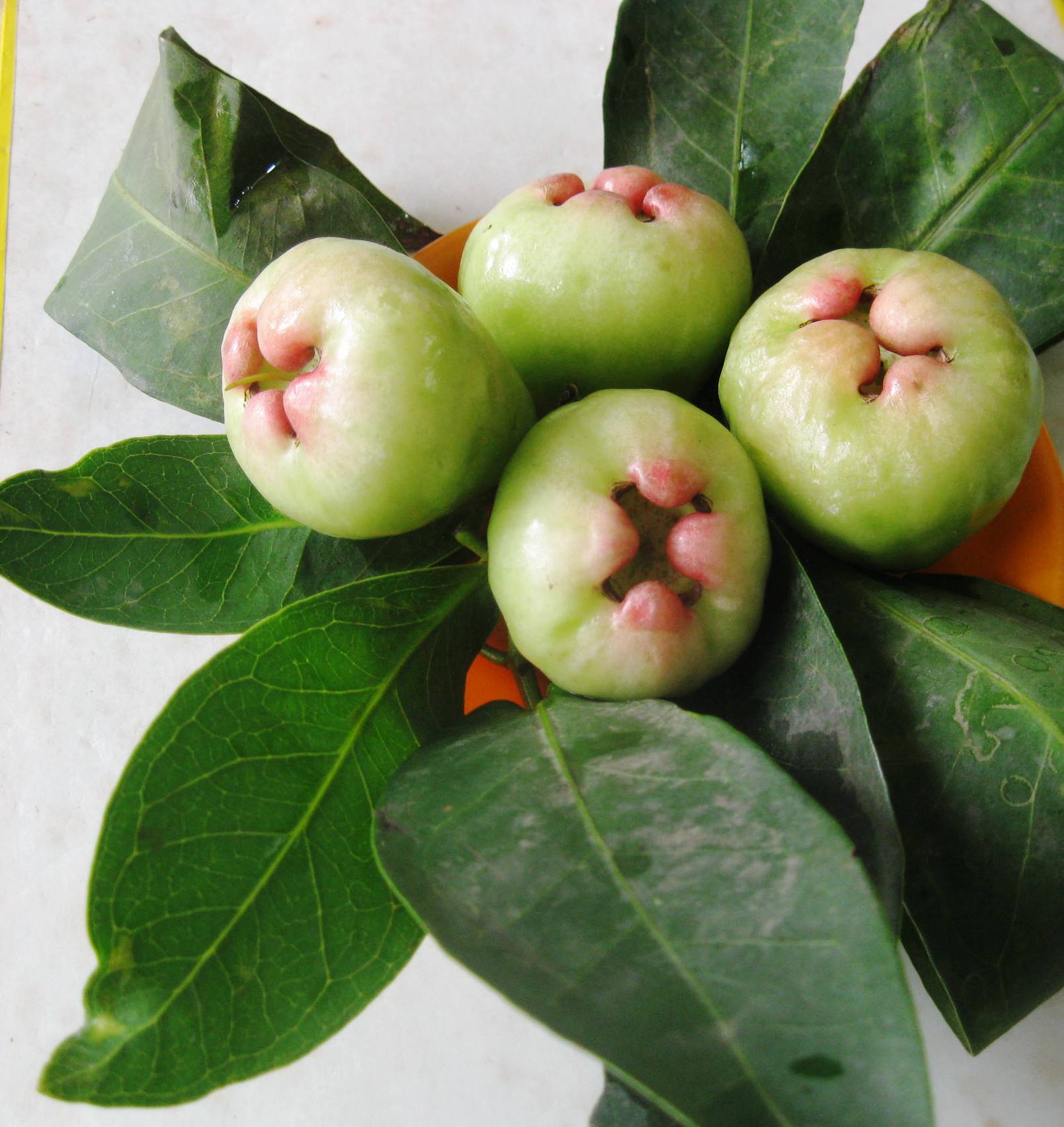 Wax apple — Leaves & fruit
 Wax apple — Fruit
 Wax apple — Fruit (2)Wax apple — TrunkWax apple — Tree
Overview
Wax apple (Syzygium samarangense), also called Java apple or water apple, is a small tree of the myrtle family (Myrtaceae) native to insular Southeast Asia. It grows 5–15 m tall with a broad crown, low branching and grey bark. The leaves are opposite, ovate to oblong, smooth and clearly veined. Bisexual flowers are clustered in the leaf axils or at the tips, with many pale-yellow stamens. The bell-shaped fruit has glossy, waxy skin that may be pink, red, green or white depending on the cultivar; the flesh inside is crisp, juicy and white with a mild sweet taste. Fruits usually contain 1–2 small seeds, but cultivars often have few or none. Wax apple prefers a hot, humid tropical climate, is propagated by seed or grafting and begins fruiting after 3–4 years, mainly in the dry season. In Vietnam it is widely grown in the south and in some central provinces.
Life cycle
From seed to productTree
https://thumb.wikimedia.org/wikipedia/commons/thumb/1/18/Syzygium_samarangense_in_China.jpg/1920px-Syzygium_samarangense_in_China.jpg
Leaves & fruit
https://upload.wikimedia.org/wikipedia/commons/e/e4/Wax_apple_%28Syzygium_samarangense%29_with_leaves.jpg
Fruit
https://thumb.wikimedia.org/wikipedia/commons/thumb/3/31/Syzygium_samarangense_fruit_Kerala_2.jpg/1920px-Syzygium_samarangense_fruit_Kerala_2.jpg
Trunk
https://upload.wikimedia.org/wikipedia/commons/a/aa/Wax_apple_%28Syzygium_samarangense%29_Tree_lower_trunk.jpg
Distribution & origin
Share of recorded occurrences by region- Vietnam30%
- Southeast Asia (Thailand, Malaysia, Indonesia)25%
- Taiwan20%
- India & Sri Lanka15%
- Others (China, the Americas)10%
Chemical composition
Relative content in agarwood resin- Water90%
- Carbohydrates8%
- Fibre1%
- Protein0.5%
- Minerals & vitamins0.3%
- Others0.2%
Uses
- Fresh eating: crisp, cool, low-sugar fruit eaten directly for refreshment
- Processing: jams, salads, juice, candied
- Folk medicine: bark, leaves and roots are antibacterial; used for diarrhoea
- Ornamental: home-garden fruit tree and bonsai (curved trunk, fine crown)
Properties
- Form
- Small tree
- Fruit
- Bell-shaped, glossy
- Nature
- Cooling, mildly sweet
- Value
- Eaten fresh, refreshing, low in calories
Habitat & conservation
Wax apple prefers a hot, humid, sunny tropical climate and fertile, well-drained alluvial soil. It is propagated by seed or grafting and fruits after 3–4 years. Fruits ripen mainly in the dry season, with several harvests. In Vietnam it is widely grown in the Mekong Delta, the Southeast and some central provinces.
Conservation
A widely cultivated species, not yet assessed by IUCN (NE). An important fruit tree in Taiwan and Southeast Asia. Myrtle family (Myrtaceae), genus Syzygium.
References
- 1Plants of the World Online — Syzygium samarangense (Blume) Merr. & L.M.Perry — Kew Science, 2026
- 2Wax apple — mô tả, trồng trọt, sử dụng — Wikipedia tiếng Anh, 2026
- 3Roi — đặc điểm, công dụng — Wikipedia tiếng Việt, 2026
- 4蓮霧 Syzygium samarangense — 形態、用途 — Wikipedia tiếng Trung, 2026
- 5Nguồn ảnh: Dinkun Chen (CC BY-SA 4.0) / Cun Cun (CC BY-SA 4.0) / Salil Kumar Mukherjee (CC BY-SA 4.0) — Wikimedia Commons,
- 6Nguồn ảnh: Slashme (CC BY-SA 4.0) / Filo gèn' (CC BY-SA 4.0) — Wikimedia Commons,