Arabica coffee
Coffea arabica L.
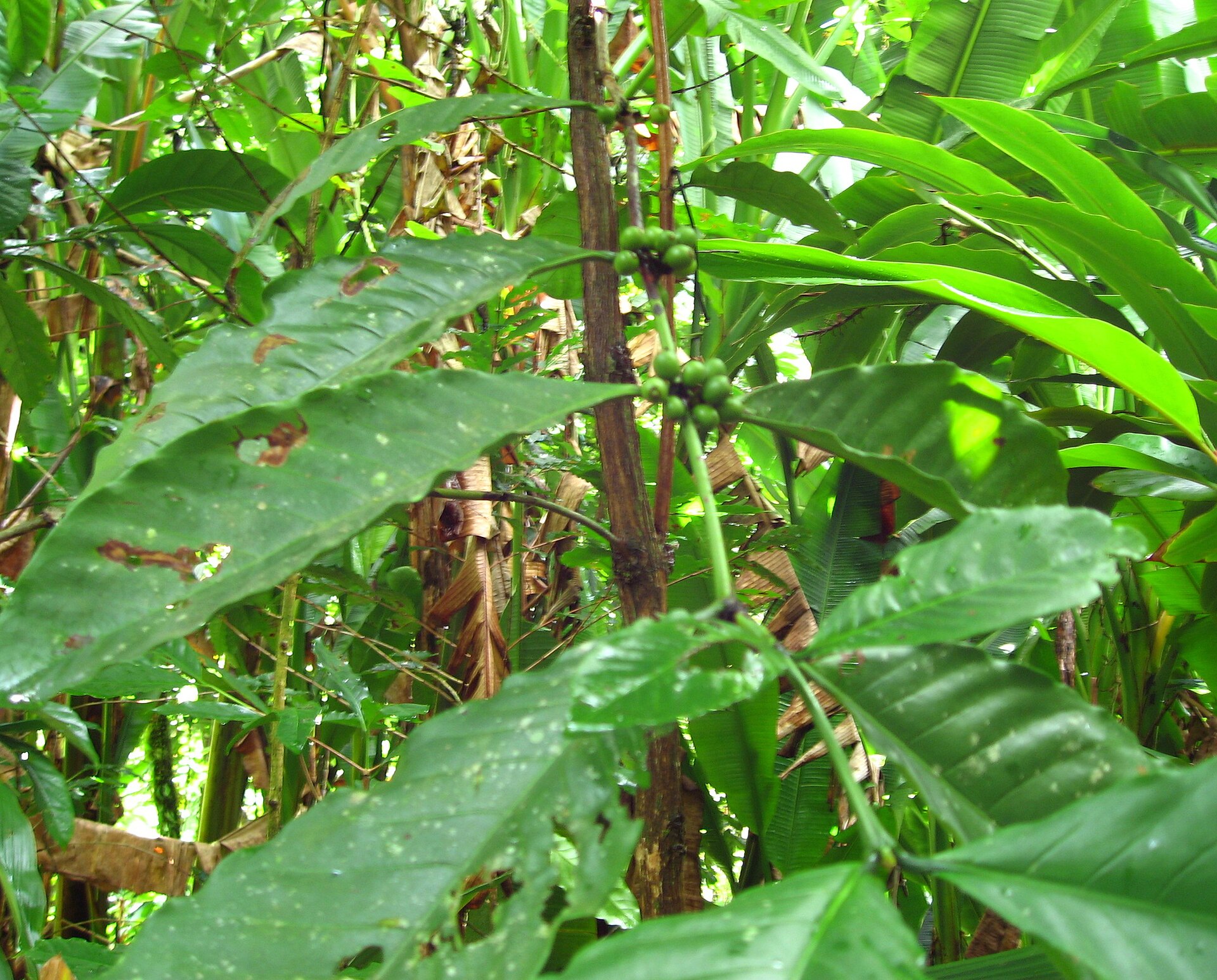
Arabica coffee (Coffea arabica) is an evergreen shrub of the coffee family whose red berries hold two beans; the world's most widely grown coffee species, native to highland Ethiopia and grown mainly in Vietnam's Central Highlands.
No ratings yet — be the first!
Gallery
 Coffee — Cherry & beansCà phê · ảnh 1
 Lá xanh
 Cà phê · ảnh 3
 Coffee — Plantation
 Coffee — Fruiting branchCoffee — Cherry & beansCà phê · ảnh 1
Photo credits: Liné1 (CC BY 2.5) · H. Zell (CC BY-SA 3.0) · Los investigadores (CC BY-SA 3.0)
Overview
Arabica coffee is a small evergreen tree native to the highland forests of Ethiopia and South Sudan, where it grows under canopy shade. It prefers cool conditions of roughly 15 – 24 °C on fertile, well-drained soils and yields its first crop three to four years after planting.
Fruit grows in clusters and turns from green through yellow to red as it ripens; each cherry usually holds two flat seeds separated by a central groove. Green beans contain 1 – 2% caffeine by dry weight, while chlorogenic acids and trigonelline shape the sweet-acidic profile of the brew. Arabica is an allotetraploid (2n = 44) derived from African coffee species.
Life cycle
From seed to productSeed
Each cherry holds two flat seeds with a central groove — the coffee bean. Growers use fresh seed and keep it evenly moist ahead of sowing.
Germination
Fresh coffee seeds germinate in 2 – 4 weeks with even moisture; the sprout grows slowly and needs shade and high humidity.
Seedling
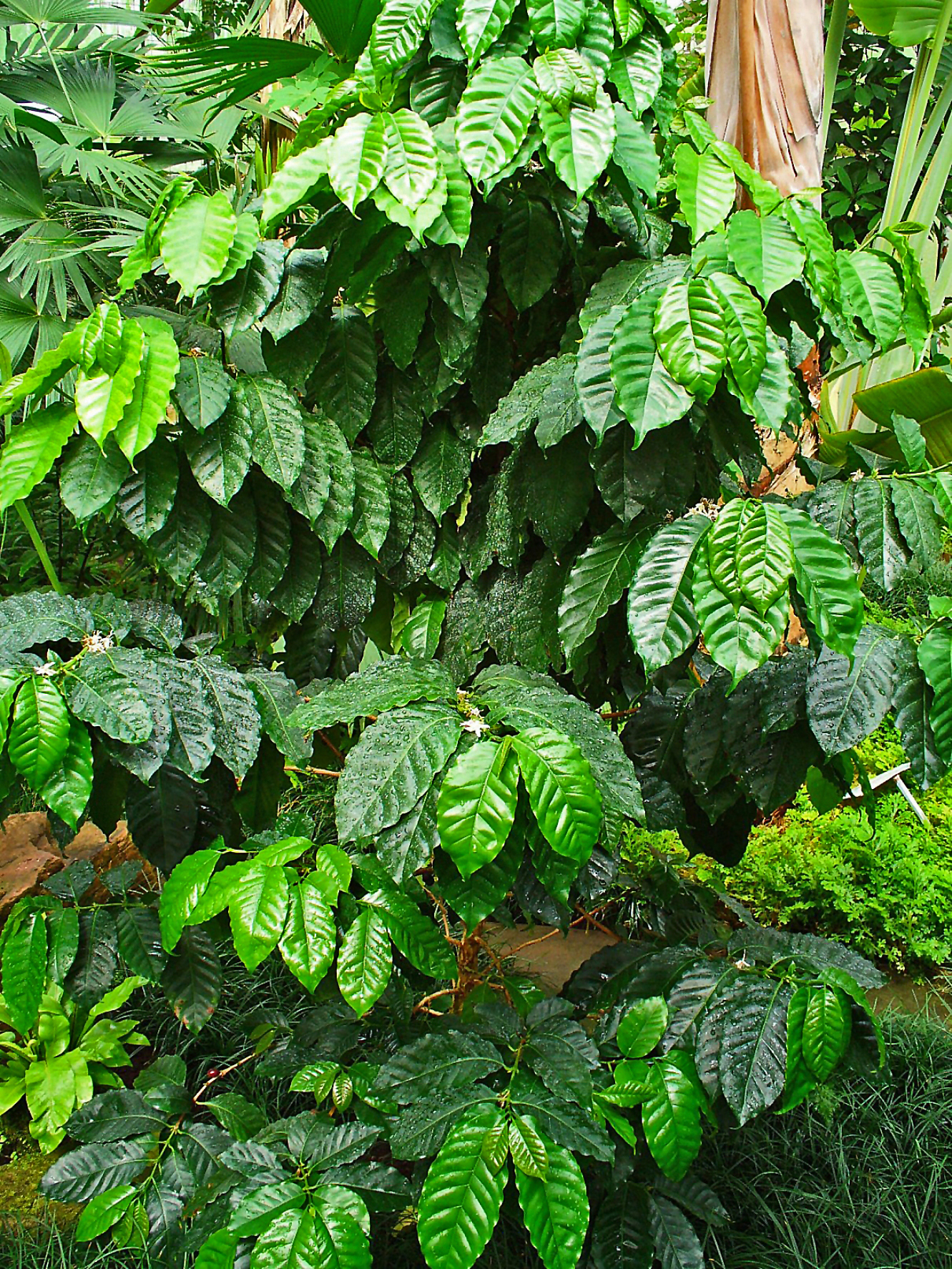
After 6 – 12 months seedlings reach 30 – 50 cm with dark green leaves; nurseries typically shade 50 – 70% of light before transplanting.
Mature plant
A small evergreen tree favouring cool highland conditions of 15 – 24 °C on fertile, well-drained soil; three to four years after planting it matures and begins to bear.
Flowering & fruiting
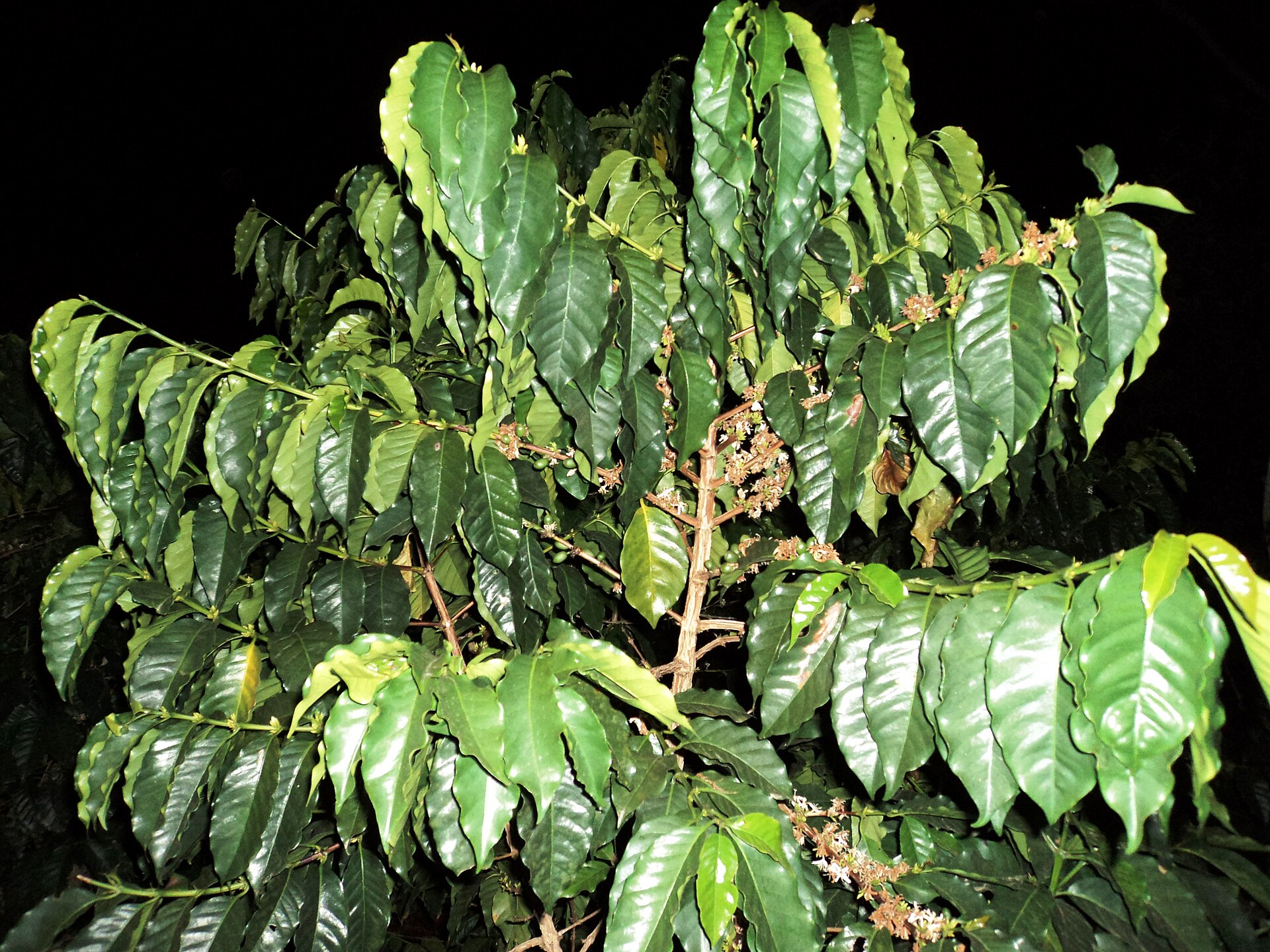
Fragrant white flowers cluster in the leaf axils; the green fruit swells and ripens red after about 8 – 11 months.
Harvest
Ripe cherries are hand-picked or machine-shaken, then processed by the wet method (pulping, fermenting, washing, drying) or the dry method to yield green coffee for roasting.
Distribution & origin
Share of recorded occurrences by region- Brazil40%
- Colombia14%
- Ethiopia10%
- Central America (Guatemala, Honduras)9%
- Vietnam & Indonesia12%
- Other regions15%
Chemical composition
Relative content in agarwood resin- Dietary fibre & polysaccharidesSeed cell-wall matrix42%
- LipidsCaffeoylquinic oils in the bean18%
- Chlorogenic acids≈ 5 – 8% of dry weight, gives acidity16%
- Caffeine1 – 2% of dry weight7%
- Trigonelline & phenolicsContributes to roast aromas17%
Uses
- Beverages: espresso, filter, drip and phin brewing
- Food ingredient in cakes, confectionery and ice cream
- Natural caffeine extraction for energy drinks
- Spent grounds used in exfoliants and as plant mulch
Properties
- Taste & aroma
- Sweet-acidic, fruity to cocoa notes
- Bean shape
- Oval, central groove along the flat face
- Typical roast range
- 180 – 230 °C
- Genome
- Allotetraploid, 2n = 44
Habitat & conservation
Tropical highland forest and mountain slopes at 600 – 2,000 m, with 1,500 – 2,000 mm of rain a year on deep, organic, well-drained soils. Young plants are shade-tolerant and plantations usually keep shade trees.
Conservation
Listed as Endangered (EN) by the IUCN in the 2020 assessment (Moat et al., e.T18289789): once climate projections are factored in, suitable habitat for wild populations across the Ethiopian, South Sudanese and Yemeni highlands contracts sharply compared with the original Least Concern reading. Because most global supply comes from cultivars with a narrow genetic base, conservation focuses on protecting wild stands and native gene banks.
References
- 1Coffee Market Report — , 2024
- 2Coffee: World Markets and Trade — , 2024
- 3Plants of the World Online — Coffea arabica — , 2023
- 4Coffea arabica — IUCN Red List e.T18289789 (bản đánh giá 2020) — , 2020
- 5Nguồn ảnh: Roger Burger (CC0) — Wikimedia Commons,
- 6Nguồn ảnh: Forest & Kim Starr (CC BY 3.0) / CC BY-SA 3.0 — Wikimedia Commons,