Rubber tree
Hevea brasiliensis (Willd. ex A.Juss.) Müll.Arg.
The rubber tree (Hevea brasiliensis) is a large Amazonian tree grown across Southeast Asia for its latex, the raw material of natural rubber — the polymer polyisoprene.
No ratings yet — be the first!
Gallery
 Rubber — Latex collection

 Rubber tree — Plant
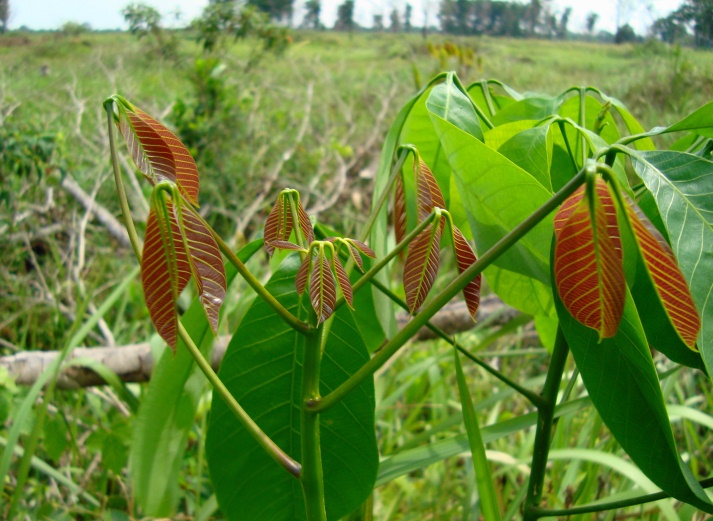
 Rubber tree — LeavesRubber — Latex collection
Photo credits: Wagino 20100516 (CC BY-SA 3.0)
Overview
The rubber tree grows 25 – 35 m tall with trifoliate leaves; its bark holds a network of laticifer tubes. Tapping cuts a shallow spiral groove every two to three days so latex drains into a cup without killing the tree, and a plantation stays productive for 25 – 30 years.
Fresh latex is a white emulsion that is about 92% dry rubber — cis-1,4-polyisoprene — plus proteins, lipids and plant resins. Most South American plantations were abandoned after South American leaf blight (Microcyclus ulel), so world output shifted to Asia. Latex is preserved with ammonia or coagulated with acid into block rubber (TSR) and smoked sheets.
Life cycle
From seed to productSeed
Rubber seeds are large but cannot be stored for long, so they must be sown fresh.
Germination
In warm, humid conditions seeds germinate within 1 – 3 weeks.
Seedling
Seedlings grow fast and love full sun; they are planted in rows together with shade or fertiliser trees.
Mature plant
The mature tree is a large 25 – 35 m forest tree; five to seven years after planting the trunk is thick enough for tapping to begin.
Tapping
A spiral cut reaches the laticifer layer just above the wood and latex flows into a cup; trees rest during the dry season to recover.
Harvest
Fresh latex is collected regularly from the cuts, preserved with ammonia or coagulated with acid, then dried into block rubber (TSR) and smoked sheets.
Distribution & origin
Share of recorded occurrences by region- Thailand21%
- Indonesia16%
- Vietnam13%
- China9%
- India8%
- Africa, South America & others33%
Chemical composition
Relative content in agarwood resin- cis-1,4-PolyisopreneElastic polymer backbone92%
- ProteinsResponsible for latex allergy3%
- Resins & flavonoidsPlant resins causing yellowing3%
- Ash & impuritiesBound minerals and salts2%
Uses
- Tyres, inner soles and shoe soles
- Medical gloves, condoms and surgical tubing
- Drive belts, conveyor belts and vibration mounts
- Rubber compounds, chewing-gum base and insulation
Properties
- Fresh latex colour
- Opaque white
- Specific gravity
- 0.91 – 0.93 g/cm³
- Glass transition
- ≈ −70 °C
- Polymer content
- ≈ 92% dry rubber
Habitat & conservation
Humid Amazon rainforest on well-drained loamy soils at 25 – 30 °C with 1,500 – 3,000 mm of rain a year. It is light-demanding, fast-growing and briefly deciduous in the short dry season.
Conservation
Not Evaluated (NE) by the IUCN, since the species is widespread in plantations. Wild genetic resources in the Amazon are threatened by deforestation and South American leaf blight; in plantations the main risks are Phytophthora root disease and over-tapping.
References
- 1Statistical Report of the International Rubber Study Group — , 2024
- 2Natural Rubber: World Markets and Trade — , 2024
- 3FAOSTAT — Forestry and Rubber data — , 2023
- 4Natural rubber — lịch sử trồng, cạo mủ, chế biến — English Wikipedia, 2026
- 5Cao su (cây cao su) — trồng trọt, cạo mủ tại Việt Nam — Vietnamese Wikipedia, 2026
- 6Nguồn ảnh: KENPEI (CC BY-SA 3.0) / Rojypala (Public Domain) / Vis M (CC BY-SA 4.0) — Wikimedia Commons,