Cabbage
Brassica oleracea var. capitata L.
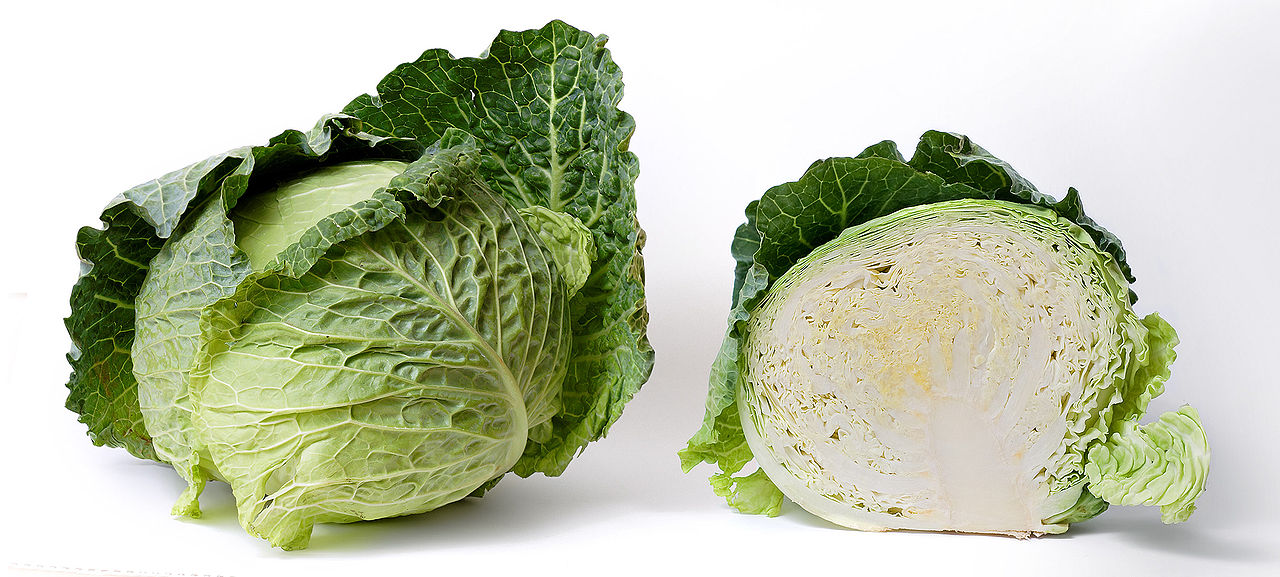
Cabbage (Brassica oleracea var. capitata) is a herb of the mustard family whose leaves fold tightly into a head; rich in vitamin C, fibre and glucosinolates, it is a common vegetable eaten raw, stir-fried, boiled or fermented.
No ratings yet — be the first!
Gallery
Cabbage headOverview
Cabbage is a biennial herb; in the first year outer leaves spread wide while inner young leaves fold tightly into a spherical to flattened head weighing 0.5–4 kg, with thick, crisp leaves showing raised white veins and a thin waxy bloom. In the second year the plant bolts, producing four-petalled yellow flowers and siliques filled with brown-black seeds.
Cabbage descends from wild Mediterranean cabbage, was domesticated in Europe in the Middle Ages and is now grown worldwide; in Vietnam it is mainly grown in the cool highlands of Đà Lạt and Sa Pa. It is eaten raw (salad, gỏi), stir-fried, boiled or stuffed, and especially fermented as pickles; it is also the base of kimchi and sauerkraut.
Distribution & origin
Share of recorded occurrences by region- Europe30%
- China30%
- Vietnam10%
- Others30%
Chemical composition
Relative content in agarwood resin- Vitamin CImmune support35%
- GlucosinolatesCharacteristic mustard-family compounds30%
- Dietary fibreSupports digestion35%
Uses
- Eaten raw, boiled, stir-fried or stuffed
- Fermented into pickled cabbage
- Base for kimchi and sauerkraut
Properties
- Taste
- Crisp, mildly sweet, slightly pungent
- Value
- Rich in vitamin C and fibre
Habitat & conservation
Cool, moist climate, 15–20°C; fertile, friable soil.
Conservation
Cultivated worldwide; not threatened.
References
- 1Kew Science – Plants of the World Online: Brassica oleracea — Kew (Plants of the World Online), 2026
- 2Wikipedia – Cabbage — Wikipedia, 2026