
Chinese mugwort
Artemisia argyi H.Lév. & Vaniot
Chinese mugwort (Artemisia argyi) is a perennial herb 0.3–1.5 m tall with silvery-white leaf undersides and a strong aroma — a traditional East Asian medicinal and ceremonial plant whose oil is rich in 1,8-cineole, camphor and thujone.
No ratings yet — be the first!
Gallery
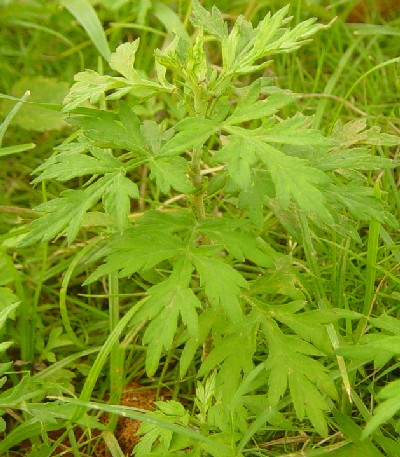 Mugwort plotMugwort leaves
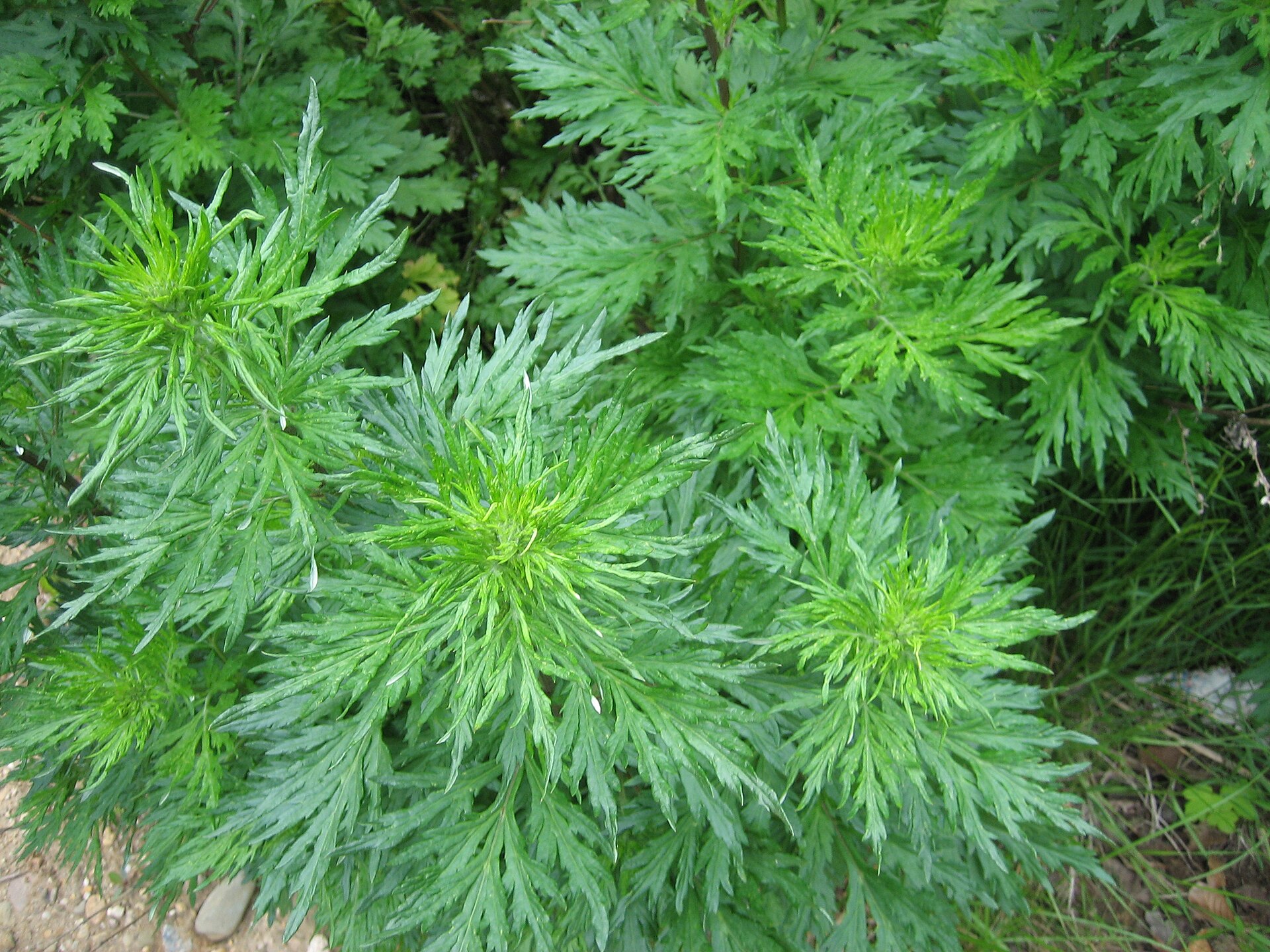 Burning mugwort incenseMugwort plotMugwort leaves
Photo credits: No machine-readable author provided. Rita~commonswiki assumed (based on copyright claims). (CC BY-SA 3.0) · Original uploader was 竹围墙 at zh.wikipedia (CC BY-SA 3.0)
Overview
Chinese mugwort is an upright herbaceous perennial about 0.3–1.5 m tall with short branches and a creeping rhizome. Its stalked leaves are alternate and ovate, deeply divided into lance-shaped lobes with small marginal teeth — lower leaves are nearly bipinnate, upper leaves three-partite and bract leaves narrow and simple. The upper surface is green, pubescent and dotted with oil glands, while the lower surface is densely white-tomentose; the whole plant is strongly aromatic when crushed. Small pale-yellow tubular flowers cluster in nodding spherical heads on a narrow leafy panicle, with bisexual central florets and female marginal ones.
According to Kew's Plants of the World Online, A. argyi is native to temperate East Asia — the Russian Far East (Amur, Primorye) through China — while other records add Korea, Japan and Mongolia. It is a xerophile of dry mountain slopes, steep river banks, oak-wood margins, coastal scrub, wasteland and road or railway verges, and it grows most aromatic on poor, dry soils. In Vietnam it is naturalised and planted widely from the lowlands to lower hills; it is also cultivated commercially in China (notably the long-established Qichun 'Qi Ai' type in Hubei), Korea and Japan.
The leaf-and-stem essential oil (AAEO) contains more than 200 identified metabolites — terpenes, aldehydes and ketones, alcohols and phenols, acids and esters, and alkanes. The major constituents are 1,8-cineole (eucalyptol), camphor, thujone (α/β), borneol, α-terpineol, terpinen-4-ol, β-caryophyllene, germacrene D, camphene and linalool. The Chinese Pharmacopoeia (2020) requires Ai Ye oil to contain at least 30% 1,8-cineole and no more than 15% camphor, the two marker compounds. Besides the oil, the leaves contain flavonoids (eupatilin, jaceosidin), polysaccharides and triterpenoids, and oil content peaks in late spring and early summer before flowering.
A review by Gao and Lu (Frontiers in Pharmacology, 2026) summarises AAEO's pharmacology: antioxidant activity (DPPH IC50 ≈ 0.31 µL/mL; 91.4% ABTS scavenging at 0.45 mg/mL), anti-inflammatory action (up to 84% inhibition of TPA-induced mouse ear oedema, comparable to indomethacin, via JAK/STAT and NF-κB pathways), broad antimicrobial activity (Staphylococcus aureus, Escherichia coli, Pseudomonas aeruginosa, Candida albicans), antiviral effects (inhibition of hepatitis B virus DNA replication through the TLR7–MyD88–IFN pathway) and in-vitro anticancer activity. In East Asian tradition the dried leaves are burnt for moxibustion, used in steam therapy or warm compresses, or decocted; in Vietnam mugwort is stewed with black chicken, added to soups, brewed as tea and used in herbal baths. The fine leaf fibres were historically used as a binder in Chinese seal-stamp paste.
On safety, thujone is a ketone monoterpene that can be neurotoxic at high doses; although AAEO showed no obvious acute toxicity in mice up to 3,000 mg/kg and an observational trial at the University of Freiburg (NCT01126931) examined its effect on appetite, human evidence remains limited. Essential oil should not be taken internally or used in large doses during pregnancy, as some Artemisia species stimulate the uterus. Artemisia argyi is listed as Not Evaluated (NE) by the IUCN and is not covered by CITES; it is common, easily found and widely cultivated, so it faces no significant conservation pressure.
Life cycle
From seed to productSeed
Mugwort seeds are tiny; they are sown on moist, fertile soil and not buried deeply so light can reach them.
Germination
Seed needs light to germinate in moist soil; besides, the rhizome also pushes up new shoots around the parent plant.
Seedling
Young shoots rise erect with green leaves on both surfaces; the foliage is soft and aromatic, ideal for culinary and medicinal picking.
Mature plant
Plants reach 0,3–1,5 m with strongly scented leaves; small yellow flower clusters appear at summer's end, when leaf oil content begins to fall.
Harvest
Leaves are picked before flowering, sun- or dried, then used whole, pounded into moxa floss or prepared as tea.
Distribution & origin
Share of recorded occurrences by region- China55%
- Vietnam14%
- Korea11%
- Japan7%
- Taiwan, China5%
- Russian Far East & others8%
Chemical composition
Relative content in agarwood resin- 1,8-CineoleCool decongestant marker; ≥ 30% per Pharmacopoeia32%
- CamphorWarm, mildly stimulating; ≤ 15% per Pharmacopoeia14%
- Thujone (α+β)Chemotype-dependent; neurotoxic in excess10%
- Borneol & terpinen-4-olAlcohols; soothing and antimicrobial9%
- β-Caryophyllene & germacrene DWoody-spicy sesquiterpenes10%
- Othersα-Terpineol, camphene, linalool, α-pinene, eugenol and traces25%
Uses
- Moxibustion, warm compresses and steam therapy
- Cooking: black-chicken stew, soups and mugwort rice cakes
- Mugwort tea and herbal baths
- Burned to repel insects and freshen the air
- Research into anti-inflammatory, antimicrobial and natural mosquito-repellent products
- Leaf fibre used as a binder in traditional Chinese seal paste
Properties
- Scent
- Strong, warm, herbal-sweet; deeper when burned
- Leaves
- Two-toned; white-tomentose beneath
- Taste and nature (TCM)
- Bitter, pungent, warm; enters liver, spleen and kidney meridians
- External use effect
- Warming, mildly stimulating to circulation
- Common forms
- Dried leaf, moxa floss, essential oil
Habitat & conservation
Dry mountain slopes, steep river banks, oak-wood margins, coastal scrub, wasteland and road or railway verges; it thrives and is most aromatic on poor, dry soil. In Vietnam it grows wild and is planted widely from the lowlands to lower hills.
Conservation
Not Evaluated (NE) by the IUCN and not listed by CITES. The species is common, easily found and widely cultivated — including large commercial plantings in China — so it faces no significant conservation pressure.
References
- 1Pharmacopoeia of the People's Republic of China — Ai Ye (艾叶) — Chinese Pharmacopoeia, 2020
- 2Plants of the World Online — Artemisia argyi H.Lév. & Vaniot — Kew Science, 2024
- 3Flora of China, Vol. 20–21 — Asteraceae — Flora of China, 2011
- 4Pharmacological and bioactive properties of Artemisia argyi essential oil: a review — Frontiers in Pharmacology 16:1664658 (Gao & Lu), 2026
- 5Comparative analysis of active ingredients and potential bioactivities of essential oils from Artemisia argyi — Molecules 28(9):3927 (Wang et al.), 2023
- 6Antimutagens in Gaiyou (Artemisia argyi Lévl. et Vant.) — Journal of Agricultural and Food Chemistry 48(8) (Nakasugi et al.), 2000
- 7Antitumor activity of flavones isolated from Artemisia argyi — Planta Medica 69(3) (Seo et al.), 2003
- 8The current understanding of Artemisia argyi as a potential medicinal plant — Springer review (Pan et al.), 2025