
Chinese wedelia
Sphagneticola calendulacea (L.) Pruski
Chinese wedelia (Sphagneticola calendulacea) is a creeping herb with yellow flower heads growing in moist places; in folk medicine it is used to clear toxins and treat measles and boils.
No ratings yet — be the first!
Gallery
 Chinese wedelia — Flowering plantChinese wedelia — Plant
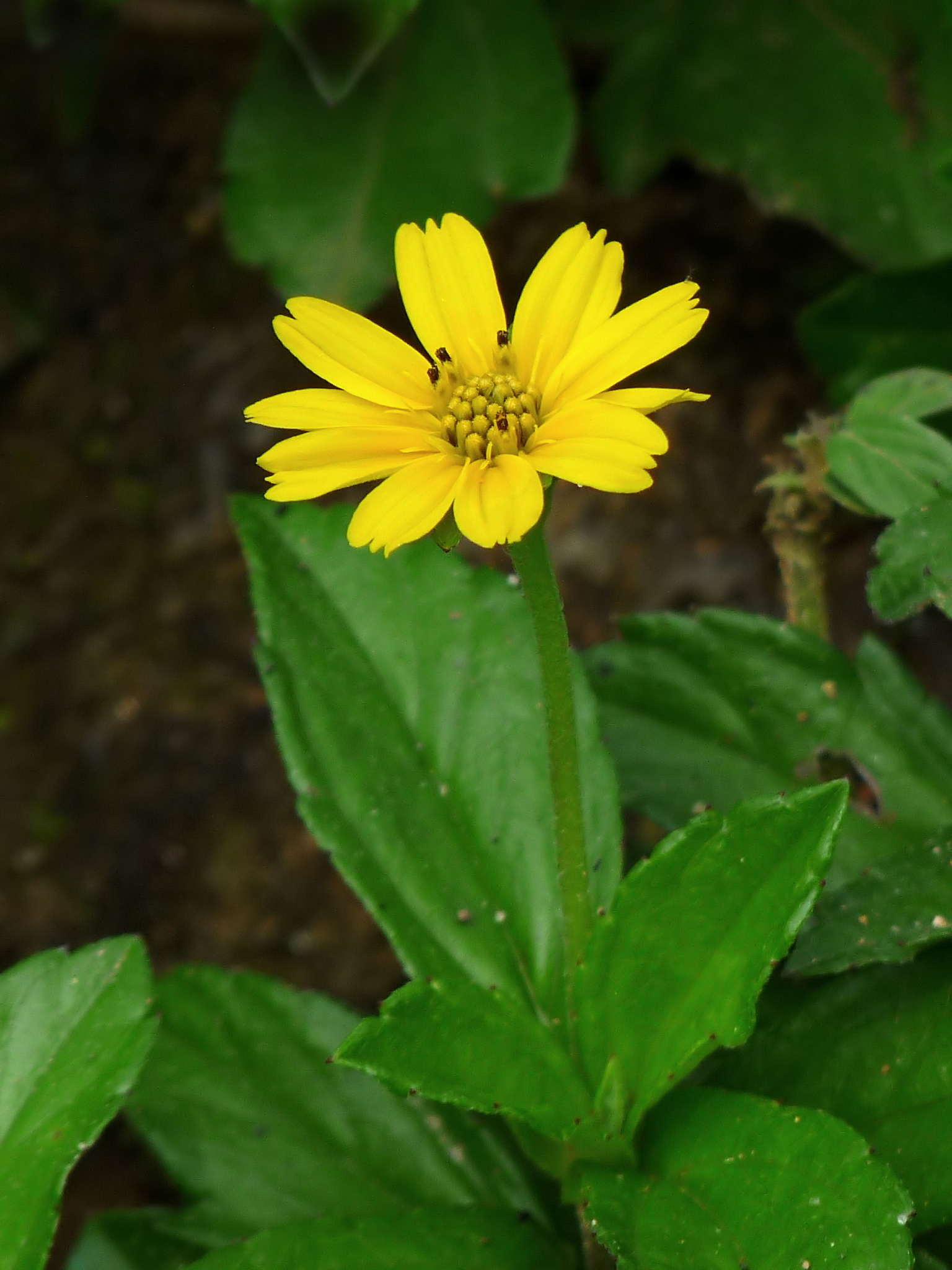 Chinese wedelia — Creeping mat
 Chinese wedelia — Leaves
 Chinese wedelia — Flower
 Chinese wedelia — Flower (2)Chinese wedelia — Flowering plantChinese wedelia — Plant
Overview
Chinese wedelia (Sphagneticola calendulacea), also called cúc nhám or ngổ núi in Vietnamese, is a perennial herb of the daisy family (Asteraceae). It has stems that creep along the ground and then rise, 20–40 cm tall, branched and covered with hairs. The opposite, lanceolate leaves are 2–7 cm long with serrated margins and rough hairs on both surfaces. The solitary flower heads are bright yellow, 2–2.5 cm across, with ray florets around disc florets. The fruit is a small hairy achene. The species likes moist, shaded places such as field edges, streamsides and waste ground, spreads quickly by runners and may flower year-round. It ranges from India and South Asia through China and Japan to Southeast Asia, including Vietnam.
Chinese wedelia is a familiar folk remedy: the whole plant is decocted to cool the body, clear toxins, support the liver and treat measles, fever and boils, or pounded and applied externally. In some places the young leaves are cooked in soup or eaten raw. Because its runners spread quickly it is also grown as a ground cover, green carpet and ornamental for its bright yellow flowers. Modern pharmacological studies show that extracts of the plant have antibacterial, antioxidant and liver-protective effects. The plant prefers a tropical or subtropical climate and is easily grown in moist spots; it is propagated from stem cuttings or seed. In Vietnam it grows widely as a wild plant and is also cultivated as a medicine.
Life cycle
From seed to productPlant
https://thumb.wikimedia.org/wikipedia/commons/thumb/b/bf/Sphagneticola_calendulacea_in_Aanakkulam.jpg/1920px-Sphagneticola_calendulacea_in_Aanakkulam.jpg
Creeping mat
https://upload.wikimedia.org/wikipedia/commons/d/d3/Sphagneticola_calendulacea_at_Aanakkulam.jpg
Leaves
https://thumb.wikimedia.org/wikipedia/commons/thumb/c/ce/Wedelia_chinensis_topview.jpg/1920px-Wedelia_chinensis_topview.jpg
Flower
https://thumb.wikimedia.org/wikipedia/commons/thumb/8/82/Chinese_Wedelia_flower.jpg/1920px-Chinese_Wedelia_flower.jpg
Distribution & origin
Share of recorded occurrences by region- Southeast Asia (incl. Vietnam)35%
- India & South Asia30%
- China & Japan20%
- Cultivated elsewhere10%
- Others5%
Chemical composition
Relative content in agarwood resin- Water80%
- Carbohydrates10%
- Fibre3%
- Minerals & vitamins3%
- Protein2.5%
- Others1.5%
Uses
- Folk medicine: whole plant decocted to cool, detoxify, support liver, treat measles, fever, boils; pounded externally
- Food: young leaves cooked in soup or eaten raw in places
- Other: ground cover, green carpet, ornamental (yellow flowers)
- Modern medicine: extracts antibacterial, antioxidant, liver-protective (research)
Properties
- Form
- Creeping herb
- Flower
- Bright yellow
- Nature
- Cooling
- Actions
- Detoxifying, cooling, anti-inflammatory
Habitat & conservation
Chinese wedelia prefers a tropical or subtropical climate and grows in moist, shaded spots such as field edges, streamsides and waste ground; it spreads quickly by runners and may flower year-round. It is propagated from stem cuttings or seed. In Vietnam it grows widely as a wild plant and is cultivated as a medicine.
Conservation
A widespread, not threatened species; listed as Least Concern (LC) by IUCN. Daisy family (Asteraceae), genus Sphagneticola.
References
- 1Plants of the World Online — Sphagneticola calendulacea (L.) Pruski — Kew Science, 2026
- 2Sphagneticola calendulacea — mô tả, phân bố, công dụng — Wikipedia tiếng Anh, 2026
- 3Sài đất — đặc điểm, công dụng, cách dùng — Wikipedia tiếng Việt, 2026
- 4蟛蜞菊 Sphagneticola calendulacea — 形態、用途 — Wikipedia tiếng Trung, 2026
- 5Nguồn ảnh: Jeevan Jose, Kerala, India (CC BY-SA 4.0) / Lorenzarius (CC BY-SA 3.0) — Wikimedia Commons,
- 6Nguồn ảnh: Vengolis (CC BY-SA 3.0) / Rathipriya Mohankumar (CC0) / Bokulful (CC BY-SA 4.0) — Wikimedia Commons,