
Onion
Allium cepa L.
The onion (Allium cepa L.) is the most widely cultivated Allium species, grown for its bulb. According to Kew POWO the species is a cultigen originating from Central Asia, known only from cultivation, with an unknown wild ancestor. The pungent bulb owes its bite to sulfur compounds: when cut, the enzymes alliinase and lachrymatory-factor synthase convert isoalliin into propanethial S-oxide (the tear-inducing factor). Onion is rich in the flavonol quercetin (quercetin 4'-glucoside, 3,4'-diglucoside), fructans, potassium and vitamin C, and is studied for antioxidant, anti-inflammatory, antimicrobial, cardiovascular and anticancer effects. Note: onions cause haemolytic anaemia in dogs and cats — never feed them to pets.
No ratings yet — be the first!
Gallery
 Onion — Flowers (var. cepa)Onion — Bulb
 Onion — Bulbs at market
 Onion — Flowers
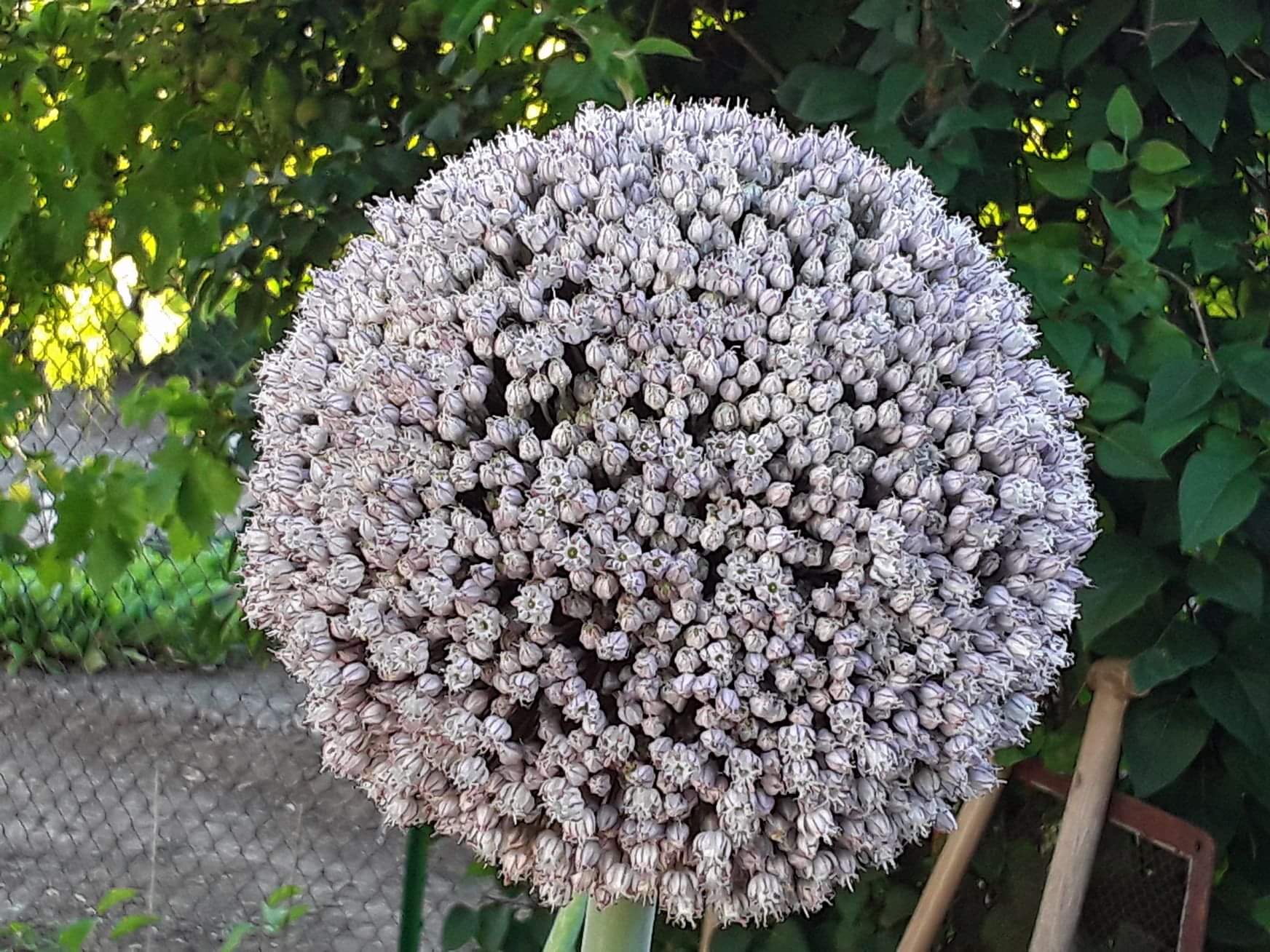 Onion — Umbellate inflorescence
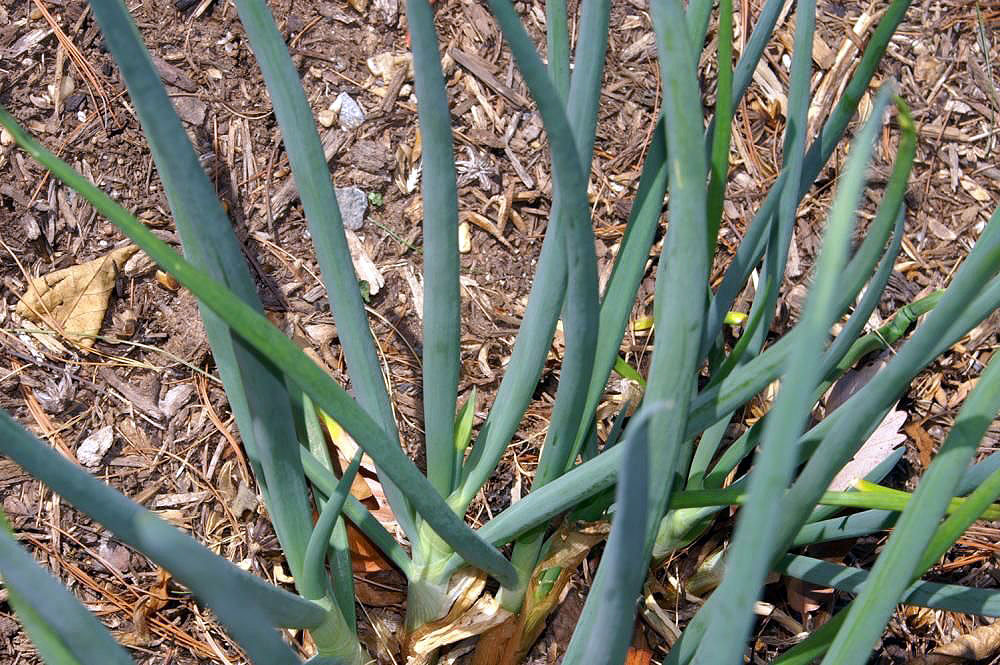
 Onion — Plants in a bedOnion — Flowers (var. cepa)Onion — Bulb
Overview
The onion (Allium cepa L.) is a biennial or perennial herb usually grown as an annual and harvested in its first season. The leaves are tubular, hollow and blue-green, arranged in a fan, about 30–60 cm long. The edible part is the bulb — actually a short, flattened stem disc bearing thick, fleshy leaf sheaths (scales) layered around a central bud; normally one bulb forms per plant, with dry outer skin coloured white, yellow, red or purple depending on cultivar. The roots are shallow and fibrous, arising from the stem disc. In the second year the plant sends up a hollow flower scape up to about 1 m tall bearing a spherical umbel of many small white-green flowers; the fruit is a three-valved capsule with black seeds. Bulb size depends on day length: “long-day” cultivars bulb under long days and “short-day” cultivars under short days, so each growing region chooses suitable varieties.
According to Kew POWO the native range of Allium cepa is given as “a cultigen from Central Asia”; it is a bulbous geophyte of the temperate biome, known only from cultivation, with an unknown wild ancestor. Many sources hold that the onion originated in Central Asia and Persia (in what is now Iran, Pakistan and Afghanistan); some phylogenetic work (Yusupov et al., 2020) instead suggests that Central Asian Allium species were not the direct ancestors of the cultivated onion, indicating a complex domestication history in which the wild ancestor may be extinct. Onions have been grown since antiquity, recorded in ancient Egypt, Greece and Rome, and then spread across Europe and Asia. According to POWO the species is now introduced and naturalised in very many regions (Europe, Asia, the Americas, Africa…), with major growing areas including China, India, the USA and many other countries. Dry onion is one of the world's highest-yielding vegetable crops — according to FAO, more than 100 million tonnes a year, led by China and India. In Vietnam onions are grown mainly in the winter–spring crop in the north.
Chemically, the most characteristic feature of the onion is its sulfur compounds. In the intact bulb these are odourless precursors, mainly cysteine sulfoxides (typically isoalliin, trans-S-1-propenyl-L-cysteine sulfoxide). When the onion is cut or crushed, the enzyme alliinase is released and converts isoalliin into sulfenic acids; in onion the enzyme lachrymatory-factor synthase (LFS) then converts part of these into propanethial S-oxide — a volatile compound that makes the eyes water (the lachrymatory factor), while other parts form thiosulfinates and compounds such as zwiebelanes. The LFS enzyme was identified and published in the journal Nature (Imai et al., 2002). As for flavonoids, onions are notably rich in quercetin: the two main glucosides are quercetin 4'-glucoside and quercetin 3,4'-diglucoside (making up most of the total flavonols); quercetin is most concentrated in the dry skin, so peeling greatly reduces it. The bulb also contains kaempferol, isorhamnetin, prebiotic fructans/oligosaccharides (FOS), soluble sugars (sucrose, glucose, fructose), phenolic acids, potassium, selenium, vitamin C, B6 and folate; red/purple onions are additionally rich in anthocyanins (mainly cyanidin derivatives), and there are characteristic sulfur compounds such as onionin A.
Onion is used mainly for its bulb, as a vegetable and flavouring: it forms the aromatic base of many dishes (mirepoix, sofrito) and is stir-fried, souped, stewed, roasted, eaten raw in salads, pickled and put in hamburgers; industry makes onion powder, dried onion, onion oil and blended seasonings. In Vietnam onions are stir-fried with beef, used in soups, salads and bánh mì, and grown mainly in the northern winter–spring crop. In traditional medicine onion is used as an antibacterial, anti-inflammatory, expectorant and circulatory and diaphoretic remedy. In research, the tear-producing LFS enzyme was published in Nature (Imai et al., 2002); several reviews (2020–2021) assess the biological activities of onion and its main constituents: antioxidant, anti-inflammatory and immunomodulatory effects (a PubMed review, 2021) and antibacterial, antiplatelet, anti-diabetic, cardiovascular, bone and neuroprotective effects (the review “Recent Advances in Bioactive Compounds, Health Functions, and Safety Concerns of Onion”, Frontiers in Nutrition, 2021); clinical trials using quercetin-rich onion-skin extract have also been conducted. The flavonol quercetin and the sulfur compounds (thiosulfinates, onionin A) are the two most-studied groups, with quercetin prominent for antioxidant activity and inhibition of inflammatory pathways.
As food, onion is safe for people at normal levels; its bite and eye-watering come from propanethial S-oxide and it may cause stomach irritation or bad breath in sensitive people, and heavy handling can cause contact dermatitis. Crucially, there is toxicity to animals: onions (and garlic) cause haemolytic anaemia in dogs and cats — sulfur compounds such as n-propyl disulfide and S-methylcysteine sulfoxide destroy red blood cells (Heinz bodies), so onions must never be fed to pets, not even cooked onion or onion powder. Some quercetin supplements made from onion skin may interact with medicines, so medical advice is advisable. On conservation, Allium cepa is Not Evaluated (NE) on the IUCN Red List and is not listed in the CITES appendices; the species is known only from cultivation and has naturalised in many places, so it is not threatened in the wild. The main risks are erosion of local variety diversity and dependence on a few commercial hybrids, together with pressure from diseases (downy mildew, onion thrips). Conservation priorities: maintaining local and traditional onion varieties and wild relatives of the genus Allium in genebanks and in situ, because they carry valuable genes for disease resistance, yield and quality.
Life cycle
From seed to productSeedling & foliage
Hollow bluish-green leaves grow in a fan; seedlings are fairly cold-hardy.
Bulbing
Once day-length is sufficient the fleshy scales swell into a bulb.
Flowering
The scape rises with a spherical white-greenish umbel and then sets seed.
Harvest & storage
When tops die down the bulbs are lifted, cured and stored in a dry, cool place.
Distribution & origin
Share of recorded occurrences by region- Central Asia · Iran · Pakistan (origin)30%
- Southwest Asia · Middle East · Mediterranean12%
- Europe16%
- China · India · East Asia24%
- Vietnam · Southeast Asia10%
- Elsewhere (the Americas, Africa, Oceania…)8%
Chemical composition
Relative content in agarwood resin- Sulfur compounds (cysteine sulfoxides, thiosulfinates, propanethial S-oxide, onionin A)Cause pungency; precursor isoalliin meets alliinase + LFS26%
- Flavonols quercetin (4'-glucoside, 3,4'-diglucoside) & kaempferolAntioxidant; highest in dry skin22%
- Fructans & oligosaccharides (FOS)Prebiotic14%
- Soluble sugars (sucrose, glucose, fructose)Give sweetness when browned10%
- Fibre & pectinIn the scale layers8%
- Vitamins (C, B6, folate) & minerals (potassium, selenium)Micronutrients12%
- Anthocyanins (red/purple onion)Cyanidin derivatives5%
- Phenolic acids & others (ferulic, caffeic acid)Antioxidant3%
Uses
- Aromatic base for many dishes (mirepoix, sofrito); stir-fried, in soups, stews, roasts, hamburgers
- Eaten raw in salads, pickled, roasted
- Vietnam: stir-fried with beef, in soups, salads, bánh mì; grown in the northern winter–spring crop
- Industrial seasoning: onion powder, dried onion, onion oil, blended seasonings
- Traditional medicine: antibacterial, anti-inflammatory, expectorant, circulatory and diaphoretic
- Research/nutrition: quercetin & sulfur compounds (antioxidant, cardiovascular, anticancer); prebiotic FOS
Properties
- Bulb
- Fleshy scales around a central bud
- Leaf
- Hollow, bluish-green, fan-shaped
- Flower
- Spherical white-greenish umbel
- Taste
- Pungent, sweetens when cooked
Habitat & conservation
Onion is a temperate crop that prefers cool weather; the optimum is about 13–24 °C, and it tolerates cold fairly well but is sensitive to hot, humid conditions. It needs loose, humus-rich, well-drained soil at pH about 6.0–6.8 and plenty of sun. Because bulbing depends on day length, growers must choose “long-day” or “short-day” varieties suited to their latitude; it is grown from seed or sets and harvested when the leaves fall over and yellow and the bulb matures. It is sensitive to waterlogging, pests and diseases (onion thrips, downy mildew) and spoils readily in damp storage. According to POWO, onion is a bulbous geophyte of the temperate biome and has naturalised in many places. In Vietnam, onion suits the cool winter–spring crop in the north and some highland areas.
Conservation
On the IUCN Red List, Allium cepa has not been evaluated (NE) and the species is not listed in the CITES appendices. It is known only from cultivation (there is no definite wild population) and has naturalised in many regions, so it is not threatened in the wild. The main risks are erosion of local and traditional variety diversity and dependence on a few commercial hybrids, together with loss of germplasm to diseases (downy mildew, onion thrips) and climate change. Conservation priorities: maintaining local and traditional onion varieties (differing in colour, flavour and season) in genebanks and on-farm, and protecting wild relatives of the genus Allium, which carry valuable genes for disease resistance, yield and bulb quality.
References
- 1Plants of the World Online — Allium cepa L. — Kew Science, 2026
- 2An onion enzyme that makes the eyes water (lachrymatory-factor synthase) — Nature 419:685 (Imai et al.), 2002
- 3A review of anti-inflammatory, antioxidant, and immunomodulatory effects of Allium cepa and its main constituents — NCBI PubMed, 2021
- 4Recent Advances in Bioactive Compounds, Health Functions, and Safety Concerns of Onion (Allium cepa L.) — Frontiers in Nutrition 8:669805, 2021
- 5Pharmacological Properties of Allium cepa, Preclinical and Clinical Evidences; A Review — NCBI PubMed, 2021
- 6Phylogenomics of Allium section Cepa (Amaryllidaceae): classification, species limits, and a new taxonomic treatment — NCBI PubMed Central, 2020
- 7Assessment report on Allium cepa L., bulbus — European Medicines Agency (EMA/HMPC), 2012
- 8FAOSTAT — Crops and livestock products (onions, dry) — Food and Agriculture Organization (FAO), 2024