Lemongrass
Cymbopogon citratus (DC.) Stapf
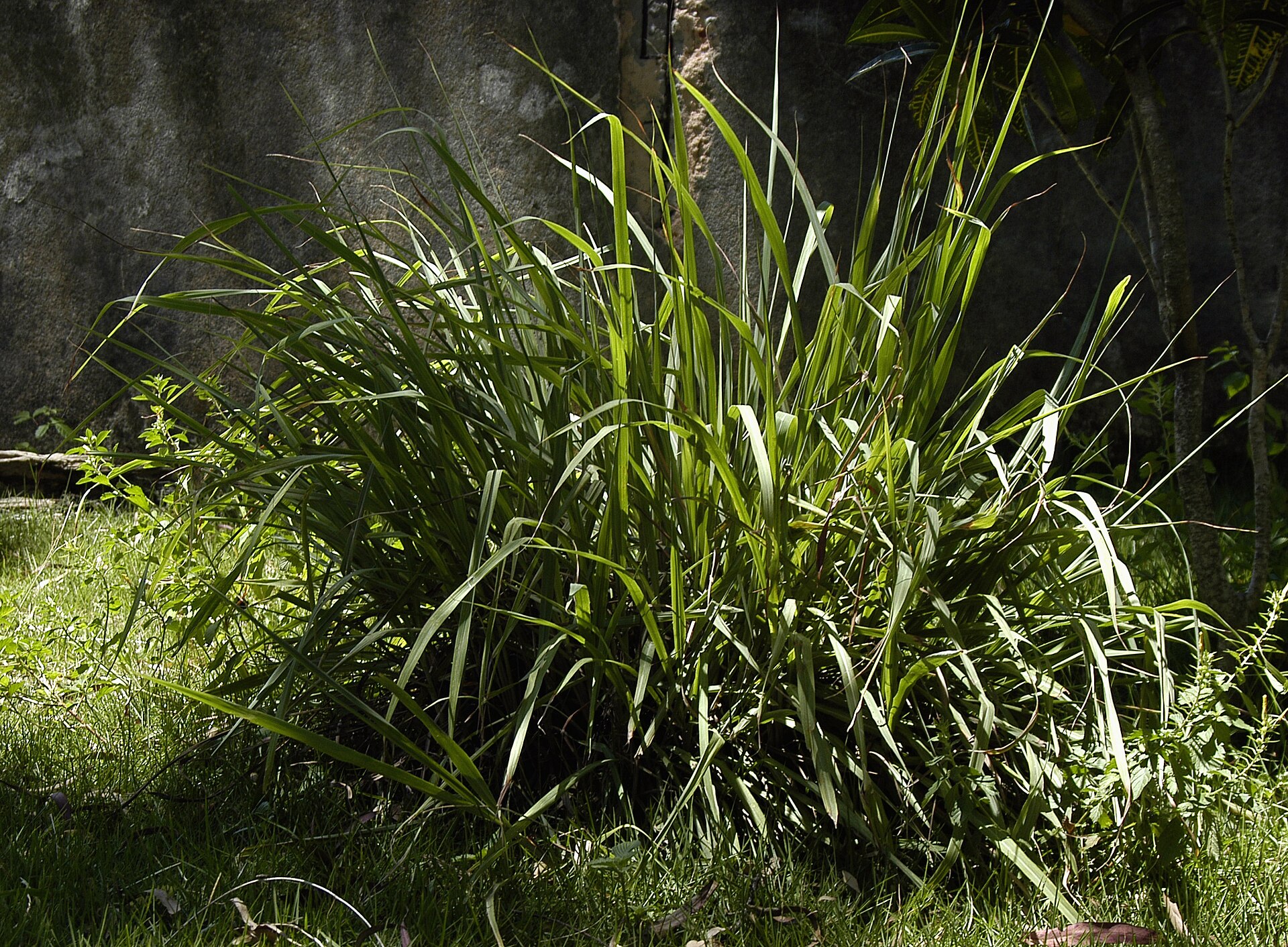
Lemongrass (Cymbopogon citratus) is a perennial aromatic grass forming dense tufts 1–1.5 m tall in the grass family Poaceae, native to South Asia (southern India and Sri Lanka) according to Kew's Plants of the World Online and now cultivated throughout the tropics. Its leaf oil is rich in citral — a geranial–neral mixture making up 65–85% — which gives the signature fresh-citrus note; the oil is a cornerstone of the fragrance industry and is being studied clinically for oral health and for controlling bacterial–fungal biofilms.
No ratings yet — be the first!
Gallery
 Lemongrass — Plant close-upRuộng sả
 Sả chanh (Cymbopogon citratus)
 Sả chanh (Cymbopogon citratus)
 Lemongrass — Clump
 Lemongrass — Base of stemsLemongrass — Plant close-upRuộng sả
Photo credits: CostaPPPR (CC BY-SA 3.0)
Overview
Lemongrass (Cymbopogon citratus) is a perennial grass forming dense tufts, usually 1–1.5 m tall and occasionally reaching 2 m, with a short rhizome and a vigorous, deep fibrous root system. Leaves are clustered in bundles, narrow-linear, 30–90 cm long and 5–15 mm wide, with long-tapering tips, smooth surfaces, slightly scabrous margins and a prominent midrib; the sheaths are smooth and often red-purple towards the base. The ligule is a thin, membranous 1–2 mm flap. The inflorescence is a 30–60 cm panicle of paired spikelets, but under cultivation the plant flowers very rarely and sets almost no seed — which is why lemongrass is propagated vegetatively by splitting tufts and planting stem cuttings rather than from seed.
According to Kew's Plants of the World Online the native range of Cymbopogon citratus is South Asia — specifically southern India and Sri Lanka — in the wet tropical biome; from there it has been introduced and become common across the tropics and subtropics. Today the main production areas include India, China, Sri Lanka, Vietnam and Guatemala, together with many countries in Southeast Asia, Africa and South America. In Vietnam, lemongrass grows and is cultivated on plains, riverbanks and footslopes from north to south, usually on loose, adequately moist soil; the plant favours full sun, and leaf biomass peaks under year-round hot, humid conditions.
Fresh leaves are steam-distilled into lemongrass oil at a yield of roughly 0.3–0.5% of fresh leaf weight, in which citral — the mixture of two citrus-scented isomers, geranial (citral A) and neral (citral B), usually in a ratio of about 1.2–2:1 — accounts for 65–85%. Besides citral the oil contains myrcene (about 5–20%), geraniol, limonene, β-caryophyllene, nerol, citronellal, 1,8-cineole and geranyl acetate. It is the monoterpene-aldehyde framework of citral that determines the characteristic fresh-citrus note and most of the oil's biological activity; leaf citral content peaks just before the plant switches to flowering, so harvest timing directly affects oil quality.
Lemongrass oil has been studied extensively for oral health: the scoping review by Kusuma et al. (Pharmaceuticals, 2024) collates clinical trials using lemongrass essential oil or lemongrass-containing mouthwash for gingivitis, periodontitis and dental caries, in some of which it matched or slightly outperformed chlorhexidine. Gao et al. (Frontiers in Cellular and Infection Microbiology, 2020) showed that lemongrass oil and citral inhibit dual-species biofilms of Staphylococcus aureus and Candida, pointing to potential in bacterial–fungal infection control. Boukhatem et al. (Libyan Journal of Medicine, 2014) reported strong anti-inflammatory and antifungal activity in vivo in a rat paw-oedema model. Shah et al. (Journal of Advanced Pharmaceutical Technology & Research, 2011) and Tibenda et al. (Frontiers in Pharmacology, 2022) review the pharmacology of the species and of the genus Cymbopogon, covering antibacterial, antioxidant, hypoglycaemic and anti-inflammatory effects in preclinical work.
On safety, citral is a well-known skin sensitiser (hapten) that can irritate skin and mucous membranes when undiluted oil is used, so it should always be diluted and kept away from the eyes; Rosol et al. (Food and Chemical Toxicology, 2023) confirm that lemongrass oil has been assessed FEMA GRAS as a food flavouring, though only for flavouring-level use. Lemongrass is quite distinct from Java citronella (C. winterianus) and Sri Lankan citronella (C. nardus) — the citronellal-rich species used as mosquito repellents — and the three must not be confused when used medicinally. For conservation, the species is Not Evaluated by the IUCN and is not listed in CITES; C. citratus is almost sterile and widely cultivated, so wild populations face little pressure, but genetic diversity is maintained mainly through clonal lines, making conservation of local landraces and tissue banks a priority.
Life cycle
From seed to productClumps & root cuttings
Lemongrass rarely sets seed; planting material is usually clumps divided from the mother plant or root cuttings, set into warm, moist soil to root.
Rooting & tillering
Within 2–4 weeks the cuttings root and tiller into dense clumps; each rooted piece becomes a new plant.
Seedling
Within the first 4–6 months the clump produces enough leaves for a first cut; culms turn succulent and oil glands become prominent.
Mature plant
Clumps reach 1–1,5 m with arching leaves; under tropical sun the leaf citral content peaks shortly before flowering.
Harvest
Fresh leaves are cut and steam-distilled the same day to capture the citral-rich oil, as heating in piles would spoil the aroma.
Distribution & origin
Share of recorded occurrences by region- India32%
- China17%
- Sri Lanka14%
- Vietnam13%
- Guatemala10%
- Other regions14%
Chemical composition
Relative content in agarwood resin- Citral (geranial + neral)Signature fresh-citrus note; drives antibacterial and antifungal activity74%
- MyrceneResinous base note of the oil10%
- GeraniolSoft rosy-floral note6%
- LimoneneCitrus-peel nuance5%
- β-CaryophylleneWoody-peppery sesquiterpene2%
- OthersNerol, citronellal, 1,8-cineole, geranyl acetate and traces3%
Uses
- Distilled into oil for perfumery, soaps, detergents and fragrances
- Culinary herb in Vietnamese, Thai and Indian cooking: soups, hotpots, curries, dips and grills
- Lemongrass tea and decoctions used to warm the stomach, aid digestion and reduce fever
- Natural mosquito and insect repellent indoors and outdoors
- Mouthwash and oral care: support against gingivitis, periodontitis and caries (Kusuma et al., 2024)
- Bacterial–fungal biofilm control and antimicrobial food preservation (Gao et al., 2020)
Properties
- Scent
- Fresh, bright citrus
- Oil colour
- Pale yellow
- Taste
- Citrusy, mildly pungent
- Distillation
- Steam distillation of fresh leaves
Habitat & conservation
Full-sun tropical and subtropical sites with evenly distributed rainfall; it favours loose, fertile, well-drained soil (sandy loam to heavier loams) with pH from slightly acid to neutral. The plant is fairly drought-tolerant and thrives on plains and footslopes, but does not tolerate prolonged waterlogging and is very frost-sensitive; POWO places the species in the wet tropical biome of South Asia.
Conservation
Not Evaluated by the IUCN and not listed in CITES. Cymbopogon citratus is widely cultivated across the tropics, almost sterile, and propagated mainly vegetatively, so wild populations face little harvesting pressure. Conservation priorities are to safeguard local landraces and genetic resources in tissue banks, maintain disease-free stock plants, and keep the species clearly distinguished from the industrial citronella grasses C. winterianus and C. nardus to avoid confusion in medicinal use.
References
- 1Plants of the World Online — Cymbopogon citratus (DC.) Stapf — Kew Science, 2024
- 2Flora of China, Vol. 22 — Poaceae (Cymbopogon) — Flora of China, 2006
- 3Exploring the Clinical Applications of Lemongrass Essential Oil: A Scoping Review — Pharmaceuticals 17(2):159 (Kusuma et al.), 2024
- 4Antimicrobial Activity of Lemongrass Essential Oil (Cymbopogon flexuosus) and Its Active Component Citral Against Dual-Species Biofilms of Staphylococcus aureus and Candida Species — Frontiers in Cellular and Infection Microbiology 10:603858 (Gao et al.), 2020
- 5Review of phytomedicine, phytochemistry, ethnopharmacology, toxicology, and pharmacological activities of Cymbopogon genus — Frontiers in Pharmacology 13:997918 (Tibenda et al.), 2022
- 6Scientific basis for the therapeutic use of Cymbopogon citratus, stapf (Lemon grass) — Journal of Advanced Pharmaceutical Technology & Research 2(1):3 (Shah et al.), 2011
- 7Lemon grass (Cymbopogon citratus) essential oil as a potent anti-inflammatory and antifungal drugs — Libyan Journal of Medicine 9:25431 (Boukhatem et al.), 2014
- 8FEMA GRAS assessment of natural flavor complexes: Lemongrass oil, chamomile oils, citronella oil and related flavoring ingredients — Food and Chemical Toxicology 175:113697 (Rosol et al.), 2023
- 9Nguồn ảnh: Undeka 11 (CC BY-SA 4.0) / Ceentia & Prathvi Acharya (CC BY-SA 4.0) — Wikimedia Commons,