
Pink shower tree
Cassia grandis L.f.
Pink shower tree (Cassia grandis) is a large leguminous tree; its peach-pink flowers bloom when the tree is leafless; the long cylindrical pods hold a sweet honey-like pulp; planted as a shade tree and the pulp is edible.
No ratings yet — be the first!
Gallery
 Pink shower — SeedsPink shower — Tree
 Pink shower — Tree (2)
 Pink shower — Leaves & young pods
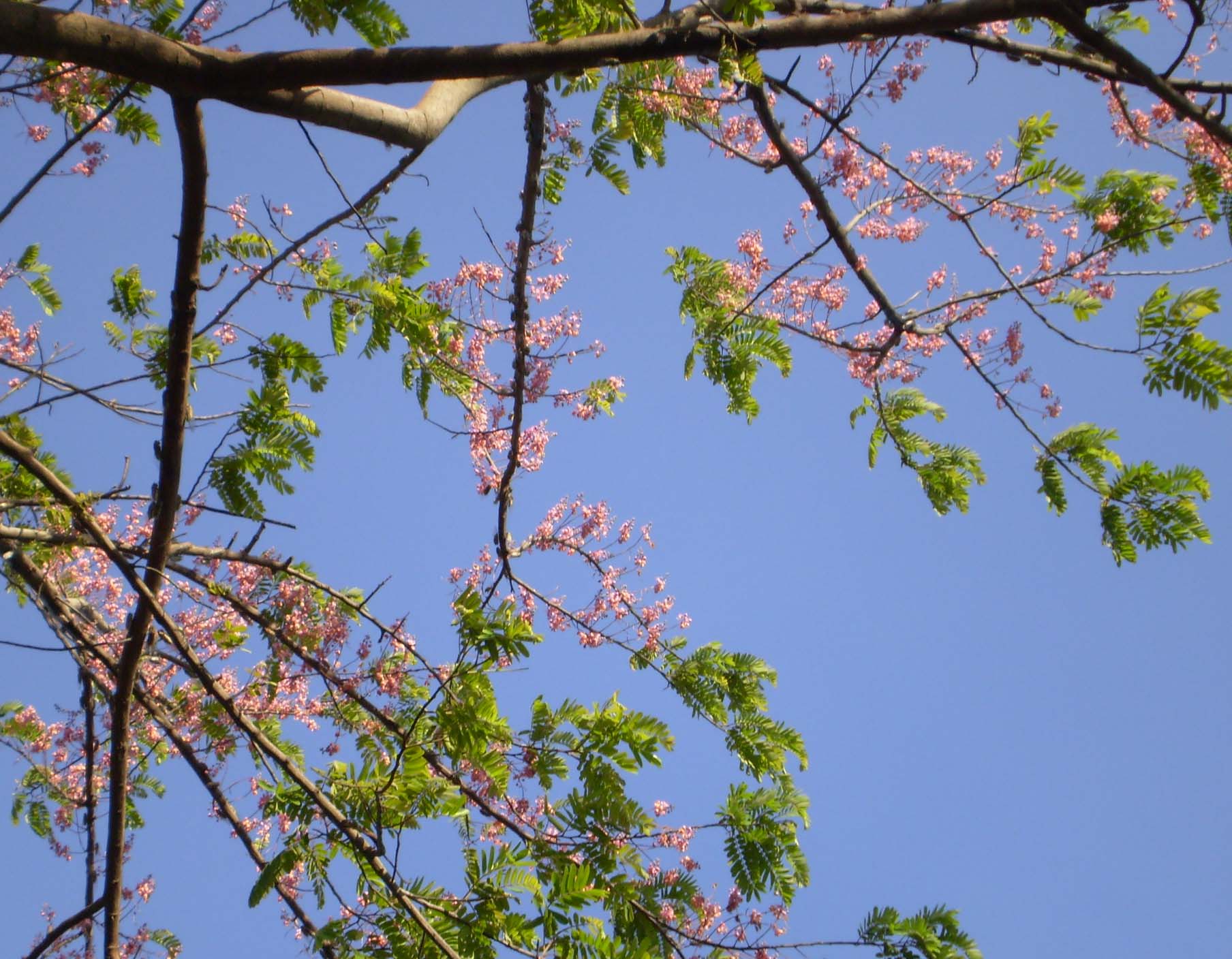 Pink shower — Flower
 Pink shower — PodPink shower — SeedsPink shower — Tree
Overview
Pink shower tree (Cassia grandis), also called coral shower, horse cassia or carao, is a large tree of the legume family (Fabaceae) native to Central and South America. It grows 15–25 m tall with a broad umbrella-shaped crown and smooth grey bark. The even-pinnate compound leaves are about 30 cm long with some 16 pairs of leaflets that are maroon beneath. In the dry season, when the tree is leafless (around March–April), it produces long axillary racemes of peach-pink flowers with a yellow patch on the upper petal, covering the whole crown. The fruit is a cylindrical brown pod up to 40 cm long, tough and woody, persisting on the tree for much of the year. Inside, papery partitions hold flat tan seeds and a thick, dark, strong-smelling but sweet honey-like pulp. Pink shower is planted throughout the tropics as a shade and ornamental tree. In Vietnam it is commonly grown in many southern provinces.
Life cycle
From seed to productTree
https://thumb.wikimedia.org/wikipedia/commons/thumb/9/9f/Cassia_grandis-2-JNTBGRI-kerala-India.jpg/1920px-Cassia_grandis-2-JNTBGRI-kerala-India.jpg
Flower
https://upload.wikimedia.org/wikipedia/commons/d/d4/Cassia_grandis_flower.jpg
Pod
https://thumb.wikimedia.org/wikipedia/commons/thumb/a/ae/Cassia_grandis_fruit.jpg/1920px-Cassia_grandis_fruit.jpg
Seeds
https://thumb.wikimedia.org/wikipedia/commons/thumb/8/87/Starr-090609-0318-Cassia_grandis-seedpod_and_seeds-Fourth_Division_Marine_Memorial_Park_Haiku-Maui_%2824667596050%29.jpg/1920px-Starr-090609-0318-Cassia_grandis-seedpod_and_seeds-Fourth_Division_Marine_Memorial_Park_Haiku-Maui_%2824667596050%29.jpg
Distribution & origin
Share of recorded occurrences by region- South America30%
- Central America & Mexico25%
- Southeast Asia (introduced)20%
- South Asia & Oceania15%
- Caribbean10%
Chemical composition
Relative content in agarwood resin- Sugars (carbohydrates)60%
- Water30%
- Minerals (iron, calcium)4%
- Protein3%
- Fibre2%
- Others1%
Uses
- Landscape: grown as a shade, street and ornamental tree (showy flowers, umbrella crown)
- Food: the honey-like pulp is mixed with milk as a drink; children eat the pulp
- Folk medicine: the iron-rich pulp is used against anaemia; roots and leaves as an antiseptic; flowers in remedies
- Other: seeds used for crafts (Hawaiian leis); wood for fuel
Properties
- Form
- Large tree, umbrella crown
- Flower
- Peach-pink
- Pod
- Long, woody, cylindrical
- Value
- Shade tree; edible pulp
Habitat & conservation
Pink shower tree is native to Central and South America and has been widely introduced across the Asian and Pacific tropics. It is sun-loving, drought-tolerant and fast-growing, and is propagated by seed. In Vietnam it is planted as a shade tree in many southern provinces; it flowers in the dry season when leafless and holds its pods for much of the year.
Conservation
A widespread and widely planted species, assessed as Least Concern (LC) by IUCN. Legume family (Fabaceae), genus Cassia.
References
- 1Plants of the World Online — Cassia grandis L.f. — Kew Science, 2026
- 2Cassia grandis — pink shower, coral shower, horse cassia — Wikipedia tiếng Anh, 2026
- 3Cassia grandis — NTBG Tropical Plant Database (IUCN Least Concern) — National Tropical Botanical Garden, 2026
- 4大果决明 Cassia grandis — 形態、用途 — Wikipedia tiếng Trung, 2026
- 5Nguồn ảnh: Yercaud-elango (CC BY-SA 4.0) / পাপৰি বৰা (CC BY-SA 4.0) — Wikimedia Commons,
- 6Nguồn ảnh: Forest and Kim Starr (CC BY 3.0 US) / DXLINH (CC BY-SA 3.0) — Wikimedia Commons,